If you would like to be a guest on my podcast to share your take on the opportunity that ductless heat pumps offer today’s HVAC contractor, please drop me a note at info at dominateductless dot com or click here to send me a note through my contact page.
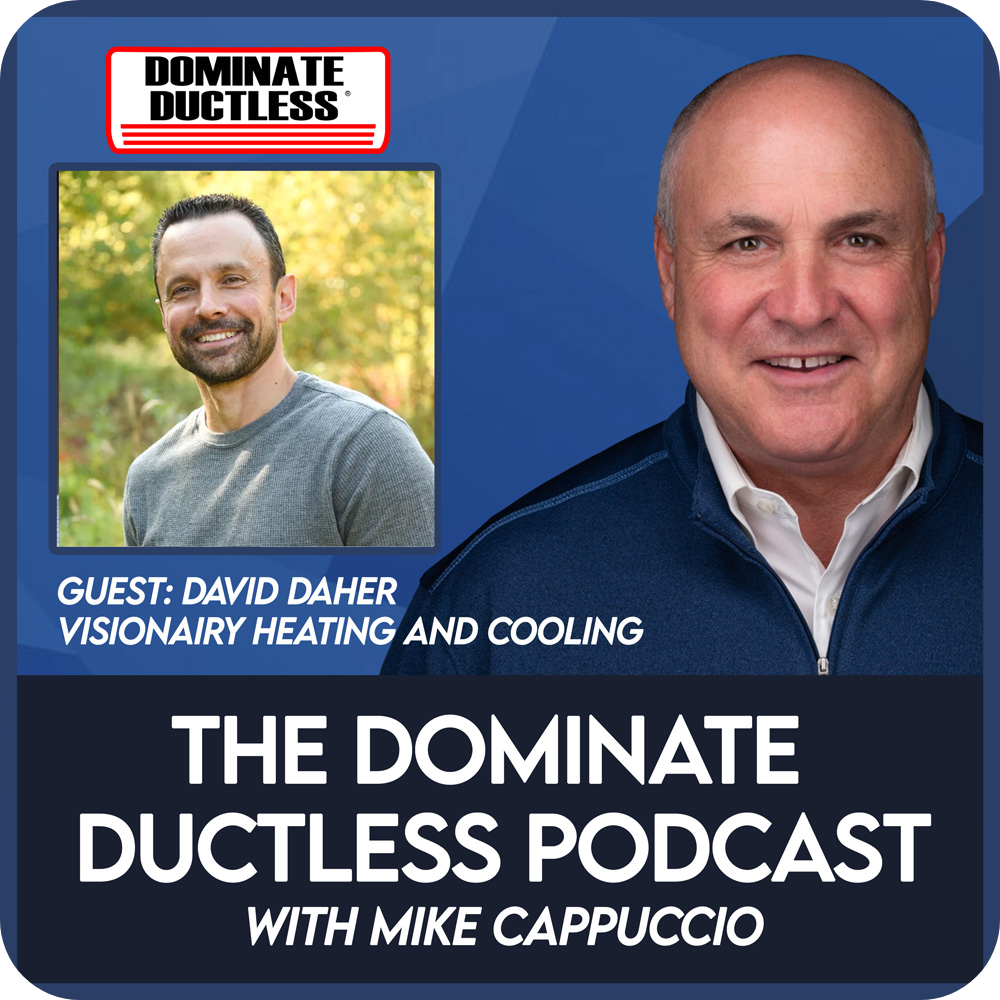
David Daher, owner of VisionAiry Heating and Cooling in Lake Elmo, Minnesota, shares his remarkable transformation from traditional HVAC contractor to 75% heat pump focused business. Starting his journey in the US Navy as a machinist mate, David transitioned into HVAC after tech school, working for someone else for seven years before launching his first company in 2011. After nearly losing everything due to bad hires in 2016, he attended Mike’s training in 2017, which “saved his company.” Within three years, he grew revenue from $600,000 to over $2 million by focusing on ductless heat pumps before selling in 2020. Now running VisionAiry as a one-man operation, David is transitioning to 100% heat pump installations by next year.

This is the comeback story every struggling contractor needs to hear.
David’s honesty about nearly losing his business due to bad hires and internal resistance to ductless technology is refreshing and relatable. What’s powerful is his willingness to admit he needed help, fly to Boston to learn, and then commit completely to implementing what he learned.
The results speak for themselves: tripling revenue in three years.
But what I love most is his “telling not selling” approach—he brings an actual wall unit to every appointment, lets customers hear how quiet it is, and offers a money-back guarantee based on comfort, not aesthetics. His advice is blunt: “You’re already behind because heat pumps are not only the future, they’re the here and now.”
At 46 with 25 years in HVAC, David’s choosing quality of life over empire-building, proving you don’t need to be a “mega conglomerate” to build a successful, profitable, low-stress heat pump business.
David’s story proves that even after nearly losing everything, a complete commitment to heat pump technology—backed by proper training and installation standards—can transform a struggling HVAC business into a thriving, lower-stress operation. The window is closing for contractors who haven’t made the transition. The future isn’t coming—it’s already here.
Listen & Subscribe:
Listen to the full episode in the player above, or listen on your preferred podcast app.



Mike: Good morning, everyone, and welcome to the Dominate Ductless Podcast, where I share the stories of HVAC contractors who are building businesses that have some kind of focus on ductless heat pumps. Um, my conversations are always usually very casual, and all of these conversations are designed to help contractors learn from experiences and insights. This morning, I am very proud and honest to say that I have a true friend here, David Daher. I’ve known God, David, and I met, I’m going to say, probably close to ten years ago now.
David: Yeah.
Mike: And David’s been—he’s moved around a little bit. I’ve seen him go from a couple different companies. And now I see he’s back as VisionAiry in—Dave’s located in Lake Elmo, Minnesota. Good morning, Dave.
David: Hey, good morning, Mike. Thanks for having me.
Mike: I’m very excited to have you here today. So, Dave, let’s give the audience a little bit about your journey and your background in this industry. I’m going to say this is probably going to be exciting to listen to.
David: Well, it started back in 1998, in the military. I joined—
Mike: What branch were you in?
David: I was in the US Navy.
Mike: Okay.
David: Yeah, I enlisted in ’97 right out of high school. Went in and got into—uh, I was technically a machinist mate, uh, on an aircraft carrier. And we made all the ventilation air, the potable water, the propulsion. We did everything that, you know, kind of the critical life features, if you will, of the ship. So that’s where it all started.
Mike: That’s where it all started. So you get out of the Navy, and where does it go from there? What happens? How do you transition from there? I mean, did you go to work for someone? Did you start your own business or what happened from there?
David: Yeah. So I actually—I knew I was going to go back to Minnesota, and we always need heating or cooling here in Minnesota. We’re doing one or the other. And so I went to tech school. I was like, well, I’m going to go get formal training. I went to tech school for two years. I did that, completed my tech school, and went right out to work for somebody else. And, uh, and I loved it. Residential, uh, doing install, service work, anything and everything I could.
Mike: Where did we first meet, Dave?
David: So you and I actually met, and I looked it up. It was August of 2017 when I flew out to your place there in Boston, Massachusetts. And, uh, I kind of stayed there with you for about 3 or 4 days, and you kind of laid the full nuts and bolts on me on what you were doing. So that’s really when we first met in person.
Mike: And I know you came out with a gentleman from Mitsubishi. Yeah. And I see him a lot now. And he is down in the Texas area now, I believe.
David: Uh, so he’s actually still in—he’s in Rice Lake, Wisconsin.
Mike: He’s in Wisconsin now.
David: Yeah.
Mike: What was his name? Was his name Mark?
David: Yep. Uh, Mark. His last name eludes me.
Mike: God, I see him a lot. And he always asks me, you know, do you still talk to David? Do you still see David? And I said, you know, I just saw David not that long ago. I said, I saw him up in Minnesota. And he was like, well, you make sure you tell him he said hello when you see him. And, you know, it’s interesting when I do see him, you know.
David: So yeah. Mark Knudson, Mark Knudson is who he is.
Mike: Yeah. Mark Knudson, that’s what it was. Okay. So you get out—get out of trade school. Now you start this. You start a business right out of trade school? Or do you go to work for somebody?
David: Yeah, I went to work for somebody for seven years.
Mike: Okay.
David: Learning the ropes.
Mike: And what makes you say I’m going to start my own business now?
David: Entrepreneurial seizure. You know, I can do it better. And you know, my boss is not doing things the way I would do it, so I just jumped in.
Mike: Do you remember day one?
David: Day one? Yeah. It’s, uh—
Mike: Tell me about day one. What was the name of that company?
David: So that was actually D.E.A.L. So it was my and my wife’s first and middle initials. So, David Earnest, Andrea Lynn, maintenance and mechanical. It was going to be HVAC with property management because we were buying rental properties at the time.
Mike: Okay.
David: So that’s kind of where it started. And the HVAC side just exploded. So I dropped the rentals, and then we renamed the company Freedom Heating and Air Conditioning.
Mike: Okay. So tell me about day one of starting this business.
David: And it was—
Mike: You probably remember it like yesterday.
David: Correct, I do actually, yeah. So I remember I put in my two-week notice, I left the place that I was working at. I didn’t even approach a single customer that my boss had because I still to this day I’m friends with him. And I went home, and I posted an ad on Craigslist, and I just waited for the phone to ring. That was my master plan.
Mike: That was the—that was the marketing plan, huh? All right, so what happens? What happens?
David: The phone rang, and I took the first call that I got, and I just ran from there. And every call that I went to after that, I stuck stickers on the equipment, and I was off and running, and I didn’t know what I didn’t know. And, uh, you know—
Mike: I find it amazing how some of these businesses start. So what happens from there? Now fast-forward the clock a little bit.
David: Well, sorry. I mean, it just exploded, to be honest. Like I was doing work out of my ears. And it was—now, to be fair, it was all primarily remodel-related work. So I was, you know, doing basement finishes or remodels. People wanted supplies and returns relocated. So a lot of ducted projects is what it primarily started out as.
Mike: So that’s what the business was originally focused on.
David: Yes, it was. Yeah, we did—I did service too, but it took a little time for that to get up and running. But it was sticking the stickers on all the equipment and doing a little bit more, uh, Craigslist marketing. Uh, you know, service kind of came along with it, and I was busy before I knew it.
Mike: So let me ask you this question. When you first started that business, did your phone ring every day? Were there any days that the phone didn’t ring?
David: I’m sure there was. In my memory, it doesn’t really seem like it did, because it seems like it was such a long time ago. Um, but I’m sure that there definitely was. But when you’re just a one-man operation, in reality, I mean, you need heating or cooling pretty much 24/7 here in Minnesota, where you don’t really have a spring or a fall where it’s mild temperatures. You know, we’re always doing something. And when you combine in the remodel work that I was doing, there was—you know, once you get in with a contractor, they go out, and they find the work, and then you just show up and do what they need you to do. So I didn’t really have to do much marketing or advertising. They just kind of came to me.
Mike: Were you ever nervous that it wasn’t going to succeed?
David: I’m still nervous to this day. I’m always just waiting for that one day where all of a sudden, you know, the phones are never going to ring again, and no one’s going to know who I am, and I’m just going to, you know, I’ll just die. Like that’s, you know—
Mike: And has that happened?
David: It hasn’t. It hasn’t. No. It’s been, you know, 14 years.
Mike: I don’t think it would. Well, let me ask you this question. When did you first encounter ductless heat pumps? What was your first—like, what was—huh?
David: That was 2014.
Mike: 2014.
David: Yeah. So—
Mike: So how does this become part of this business and what you do and, you know, look, I know it’s not your 100% focus, but you know, what was it like? What was your first encounter with it? Like, what do you remember your first installation or how it kind of came together?
David: Yeah. So I was selling American Standard equipment through the local distributor here who I had built up a friendship with their local rep, and they had been selling Mitsubishi for like 40 years. I mean, well, at that time it was probably 25 years, but it was quite a while. And so, um, he just, you know, he was like, hey, you should check out these ductless units. And I’m like, oh, okay. Well, I mean, I never say no to anything, so I at least try it out. And he’s like, just offer it every now and then when you go into a house that has a sunroom or something like that. And so I did, and I was like, man, these things are pretty awesome. I mean, there’s, you know, they’re—I don’t want to say they’re simple, but they’re not overly complicated as far as where you have to worry about doing all these other different things and figuring this out and doing that there. It’s a really easy business model to bring in and kind of bolt on to something, even just from the start. And every house has a need for one, especially here. There’s always a hot or cold spot or a room here or there in every house.
Mike: That’s exactly what I did, is I brought it on as a bolt-on to my company and just kind of really started to market it. And, you know, my first initial impressions were, I don’t want to put in a bunch of ductwork anymore when this kind of does the same thing, room by room, you know. And I just really started to market the product, and then it started to take off. But you know, what made you decide to—what’s the turning point that says, you know what, I think I’m going to start offering this. What makes you decide that?
David: Well, so it was really slow at first, just because I had employees at the time and there was resistance. Right? They were so used to just doing your typical HVAC model. We go out on a repair call. The system needs to be replaced. We replace the system, and then it just kind of cookie cutter repeat. And I started thinking to myself, because in Minneapolis, there’s a lot of older home stock. Like we have a lot of houses that have boilers and stuff like that.
Mike: It was similar to the northeast where I was.
David: Yeah. So we would go on these calls, and I’m like—and I started talking to this rep, I’m like, could we do one of these ductless systems like—but you know, can you do multiple heads? And he’s like, oh yeah, you could do five, eight heads if you wanted to. And I was like, really? So we started just kind of offering it to peopl,e and it kind of started to build up and build up. And then in 2016, I actually, unfortunately, made a couple of bad hires into the company. They almost—uh, they almost sunk the company because I almost sunk the company by making those bad hires. And those guys ended up leaving, and they were kind of the main resistance to the objection to ductless. And so when they left, and I had kind of been toying with the idea, with the assistance of my sales rep at the time, about really doing a ductless focus company. And I told them, I said, okay, well, if I’m going to do it, I want to know who’s doing it, who’s doing it at a high level. And that’s how your name kind of came into the conversation. Okay, I gotta find this guy. I need to talk to him. I need to know what he’s going to do. And so that’s how I got up to your location there back in 2017.
Mike: So the challenges were really you had some people that were resistant to it.
David: Internally? Yes.
Mike: Why do you feel they were resistant to it?
David: Just stuck in that old school mentality of this is, you know, this is what we’ve always done with HVAC, right? You get a service call, it’s broke. Your system’s old, or it’s dangerous. You need to replace it. Let’s put in a new furnace, a new air conditioner, and just kind of cookie-cutter repeat.
Mike: And you know, I still see, David, that’s still the mentality even of these bigger companies today that they’re tending to transition away from heat pumps I see sometimes because they just want that remove replace, remove replace, remove replace business. And I’m not saying don’t do that. I mean, that’s how every HVAC contractor makes their profit. And I get that, you know what I mean. But have you ever added a heat pump to a replacement system?
David: I have now. Yeah, I do it all the time. I don’t even offer air conditioning now. I mean, I’m moving towards a fully ductless-focused company, ideally again now. I’m sorry, from a one-man operation. Right. Yeah. Not that it couldn’t be scalable, but just being—it’s—
Mike: What’s the percentage in today’s market? Like how much—how many—like are you 50% heat pump, 50% unitary, 25% heat pumps, 75%? You would say the business is at right now from installing equipment segments.
David: Probably 75% heat pump.
Mike: Wow. Wow.
David: Next year, it’ll be 100%.
Mike: What? Any challenges when you’re moving to this transition now? Are there any challenges with this going on?
David: Well, in our market, a lot of the clients are demanding it. They’re actually looking for it. They know they want a heat pump, and they’re just trying to find the right company to do it. And fortunately for me, in our area, a lot of guys are talking people out of it, and they don’t know what they want.
Mike: Yeah. You know, I’m seeing that in a lot of places. There’s still a lot of contractors that don’t want—not just resistant to it, I think there’s so many myths, bad myths of things that, you know, don’t really get brought up, you know. But how do you find ductless heat pumps easier or harder to sell compared to other products, you know? Is it easier or is it harder? Or when you look at the two products, you know, what makes it easier or more difficult? What needs to be done?
David: Well, I mean, the standpoint I start with is what kind of existing system, or what is the house laid out like currently. So if I go into an older home and it’s a boiler home, I mean, 99% of the people don’t want to start talking about ripping open walls to put in ductwork and then have to soffit everything in. And so it’s—I don’t want to say it’s like shooting fish in a barrel, but that’s quite easily the answer for that situation. And that’s probably, you know, 60 to 80% of my clients are in homes like that. So it’s a no-brainer that, you know, ductless is the way to go.
Mike: Do you use these products in your own home?
David: I haven’t yet, but we built a custom home, and I have it very tight, and it’s really small. I roughed in a couple spots to add one in. I’m just not sure how long I’m going to stay here, so I haven’t done it yet.
Mike: Okay.
David: I do have a—I do have a centrally ducted heat pump. Yes, but I don’t have any ductless installed in this house.
Mike: Okay. So you go into homes, you do some selling, I would imagine. Correct?
David: Yeah. You know, I do more telling than I do selling, to be honest.
Mike: I do more telling than selling. That’s interesting.
David: Yeah. It’s, again, the demand is coming a lot from the clients, where they seek me out because they know I do heat pumps, and I love the product. And so they want to talk to me, and I let them already kind of sell themselves or they’re already usually sold. They’re primarily looking for somebody who they can trust to do the work. So I just tell them what I do differently and what, and they’re pretty well educated what the product can do. I have to inform them a little bit about how the product I use is a little bit different, but otherwise, I just tell them about it, and they, you know, they kind of jump on board.
Mike: How do they find you?
David: Usually word of mouth. It’s usually right now.
Mike: Word of mouth business, huh? Okay.
David: Yeah. I mean, I know it’s not going to last forever, so I am—but—
Mike: That runs a lot, Dave. That happens. Trust, honesty, and word of mouth is probably the best way to grow a business, I see.
David: I’ve been doing okay with it now, this second business and three years in.
Mike: So yeah, do you have to go into a home where you have to handle the DIY online pricing objections?
David: Yeah. But I overcome quite a bit of that with the product line.
Mike: You know, how do you do that?
David: Well, I mean, the quality of the product, the reputation that the company has. I mean, I personally only install Mitsubishi products, and they’ve been doing it for so long, and they build such a bulletproof product that I trust to a very high level. It, you know, it can’t really even compare. I mean, when you look at the average DIY install lasts anywhere from 2 to 6 years, you know, a Mitsubishi or a real good quality heat pump installed properly, 15, 18, 20 years out of it. So, you know, do you want to replace it three times or just do it once?
Mike: Yeah, exactly. What training or education’s most valuable to you, or what was most valuable to you when you know along this journey?
David: Well, I mean, you know, not only because I’m on your podcast, but obviously—don’t put me through—yeah. The training that you did. I’ve told you this before, but the training you took me through in 2017, it saved my company. I mean, I made those bad hires, they left the company, I came in, and over the next three years, we really focused in on ductless heat pumps. And we took the company from doing about $600,000 in revenue to over $2 million. And then I got approached by a competitor and bought out in January of 2020, and I wouldn’t have been able to do that without the training from every aspect that you provided and what you had built. And I pretty much photocopied and brought back here to Minnesota and just laid it back out the way you were doing it.
Mike: It’s not me. It’s your commitment to it. It wasn’t me. It was your commitment to it. And I find that most times it’s just somebody needs to hear it from somebody else and then go back and commit to it. Commit.
David: And you know, it’s possible.
Mike: It’s not—it’s very hard for people to do what you did, Dave, to go back and realize, you know what? I need to make some changes here. Yeah. I think, you know, people don’t—let’s be honest. People don’t like change. You know, and I think from what I’m hearing, the change helped it.
David: Oh, absolutely. It saved it. I—yeah, it definitely saved the company, turned everything around, and it worked out great. And now I’m able to do it the way I really wanted to do it on my own. And, you know, building a heat pump ductless focus company.
Mike: I mean, when you look at that, you know, what changes have you made to do this that have made the biggest impact?
David: Well, I think the biggest thing was just the belief in knowing that this stuff does—it can happen, and it works. It’s not just—it’s not just fantasy or something that we can actually talk about. Um, making that change, uh, in myself, first of all, that you can actually build a business around thi,s and it can be very successful. Again, I’m not a good example for somebody who’s trying to be like a, you know, a mega conglomerate behemoth in the industry.
Mike: You don’t need to be that, Dave. You don’t need to be a nice small, a nice small controlled company with a few people doing heat pumps is a nice little business. Yeah, money is profitable. The stress is low. Not a lot of repairs. I mean, I got a guy in Chicago that’s doing extremely well right now, and he’s only got a few guys working for him. And you don’t have to kill yourself either. You know what I mean? There’s got to be a quality of life as well as work. You know? So.
David: Oh, for sure. And now, at my age, I mean, I’ve been in HVAC for like 25 years, so I’m 46 by age. But HVAC years, I’m like 132.
Mike: So yeah. Yeah, it’s just, you know, when you’re out there, and you’re selling heat pumps, do you focus on education versus traditional sales? Like you said, I mean, you’re not selling, you’re telling.
David: Yeah, I mean, I definitely go out there, and I try to find out what does the client really want. And then what is actually, you know, practical in their home. Merge the two together and then find out a solution, you know, that’s going to work for them in their home. And, uh, yeah, I mean, I bring an actual indoor wall, high wall-mounted unit with me so that I can plug it in. They can hear how quiet it is. And you know, it’s really—you know, a lot of people might have a little bit of a preconceived notion of what this thing is going to look like on the wall and might not like it aesthetically. But then once I bring it out, and I show them, they’re like, oh, that’s not bad. You know, that would fit in there and blend in. And it does. And so, you know, I really just, you know—and lay out the quality and the installation and the stuff that I do from that piece of it. And we back everything up with a 12-year parts and labor warranty, and you know, it’s…
Mike: Do you have an interesting customer success story?
David: Yeah, yeah, I do. It’s—so we had a client who got called out, and they had a house that had some really kind of odd issues. Right. They were trying to control it, you know, in a little bit of a different way. And they were going to do a ducted system. And when I got out there, we started talking and started looking at it. And um, you know, it ended up being a three-zone system that we ended up putting in with three high-wall units for them. And, uh, they were going to have to go and bust down all these walls and then do all this demo work and remodel work and build everything back up. But after finding the ductless system and using it, I said, hey, just try it. I even told the guy, I said, you can try it for two years. If you don’t like it, I will take it out personally and give you all your money back. And within six months, he was like, this thing is fantastic. It’s quiet. I can control these individual spaces. Um, you know, he’s moved his mother-in-law into this third level that he had. And so it’s really just been a—it’s been a no-brainer. And it’s been great for him. He’s loved it.
Mike: Do you ever use him as an example in the sales process?
David: Oh, that’s my, yeah, that’s my primary—
Mike: That’s your story.
David: That’s all because that’s 90% of the houses that I’m going into.
Mike: Those are 90% of the houses that you go into, you know. And you know what I always used to tell a lot of people is, how do you handle the objection of I don’t like that on the wall? That’s an objection that you hear a lot. And I want to hear yours. I’m not going to tell you mine.
David: Well, so for me, I bring a high wall unit with me, because that’s what I’m putting in 90% of the time. I don’t—I know, especially with Mitsubishi and a lot of these other products, you can do the recessed, you can do all—I’m not—I’m 46. I’ve been in a million attics. I’m not going in attics anymore. I’m, you know, I’m going through your wall. You know, maybe we have to go through a closet and then go down or out or something like that. But when I bring that unit with me, and I show them, and they can see it, they really—they’re like, you know, at first they’re like, okay, not what I thought it was going to be like, it’s not as bad. And I’m like, okay, I said, I’ll tell you what, in two weeks, you’re not even going to realize it’s there. You’re going to be comfortable, it’s going to be quiet. You’re going to have the temperature control you want. You’re not even going to be able to see it anymore. It’s going to blend right in. And I haven’t had—I got to be approaching a thousand installations, and I haven’t had a single person complain after the fact that they’re too cool. I’m too comfortable. You know, they’re not complaining about that.
Mike: Yeah. I always used to say, you know what? I don’t like that on the wall. I always used to say, well, what’s the biggest thing that people put on your wall today? Let me ask you that question. And what are they going to—what are they going to tell me?
David: You’re telling me—
Mike: Television? And the bigger the better, correct?
David: Yeah. 80 inch, 90 inch now, 100.
Mike: And when it’s on, you see the TV great. When it’s off, it’s a big black box. Am I right or wrong? Right. No,w when you walk into that room, do you notice that TV on the wall every single time you walk into that room and say, I hate that TV on the wall because it’s a big black box, right? Yeah. All right. So I’m going to put a little white box. So you know what? Hey, I can even put a little black box because I have a little black box right here, right above my black TV in my own office. And I always say, you know what? I don’t see that there anymore. The comfort goes way beyond the black box. Yeah, because I need to be comfortable, not—I don’t see the box. I feel the comfort. Yeah. You want—that’s exactly what you’re going to see in time is because at the end of the day, it’s just a box on a wall. Like you said, the comfort is going to overcome that at any point. You know what? And if you don’t like the comfort in two weeks, I’ll come back. I’ll take it out, you know, I’ll give you your money back if you don’t like it. You don’t like the comfort.
David: If you don’t like the comfort, not the look. The comfort. Yeah. You know what I mean.
Mike: You’re not happy with your comfort level.
David: Exactly. And you never hear from them again. Because the comfort goes way above the look.
Mike: Oh, yeah.
David: The comfort goes way, way beyond the look. And I mean, you know, I just—you know, I think that’s really good. I mean, how has the team adapted to it?
Mike: Well, so it’s just me now, so. Right. I’m doing everything now, but it wouldn’t be hard to bring somebody in if they wanted to. I do have—I do have five children, and one of them is going to be—is getting to be 16. And he has come out with me on several job,s and he’s starting to show, uh, you know, signs that he wants to get into the—certainly into the trade world and may or may not be HVAC, but he definitely prefers when we’re doing ductless than ducted.
David: Okay, so I mean, advice for other contractors—what would you tell contractors if they’re not focused on heat pumps?
Mike: Right. You’re already behind because the heat pumps are not only the future, but they’re the here and now, and they’re only going to develop to whether we’re going more into air-to-water or whatever. But, you know, air conditioning alone is going away. Like, that’s—whether it’s five years or ten years, everything is going to be heat pumps in some capacity. So yeah, get in. You’re already late to the party. Get in.
David: What common mistakes should they avoid, do you think?
Mike: Oh, well, right. Don’t follow traditional installation practices. You have to do best practices. You have to do—you have to pull a proper vacuum. You have to pressure test with nitrogen. If you’re soldering, you got to purge with your nitrogen. Things that—best practices are good standards to have. Heat pumps are not like furnaces, where they’re forgiving. You have to do a proper startup and the setup of the system.
David: Yeah. That’s something we just went over in a podcast the other day with a manufacturer. And he says the biggest problems that he sees is leaks, improperly wired, improper start-ups. Just guys that are, you know, coming into the trade that are from other trades, thinking that our systems—our trade is just the snap of a finger. And it’s so easy to do. It’s just—oh, it’s just a couple flares and hanging a plastic box on the wall.
Mike: And yeah, I disagree with that. You know, it sounds easy, but I don’t think anything is easy, you know, if it’s not done right, you know. So what gives you the most optimism about the heat pump market today?
David: It’s everywhere. I mean, the opportunities are everywhere. Whether you’re doing ducted or you’re doing ductless. I mean, every home has a central system of some type. Every home has a situation where they need at least one, whether it’s a bonus room over a garage. I’ve done gazebos. I’ve done basements. I’ve done three and four-season porches. I’ve done garages. I’ve done cabins. I’ve done ice houses. I mean, there’s, you know, they’re everywhere. The opportunity is endless.
Mike: And I did a tugboat one time.
David: I did a tugboat that actually used to tug ships in from the harbor in Boston. And it would bring them in, and they had a tugboat fleet, and I did like five tugboats in the captain’s quarters, and in the tugboat, you know, in the summertime, because they were hot in there in the summertime. And they were cold in there in the wintertime. And the heat didn’t work in there. And they had 110V—I think they had 220 on the tugboat and put them in, put them on the tugboat. I put them in houseboats. I can think of some crazy applications where I put them. I always used to say to myself, wherever you can put ductwork in the traditional heating and air conditioning system, I can put a heat pump. And that was my motto. Wherever you need comfort, cooling, and heating, I can do it with this system. Somehow, someway, I can do it, and I just—it’s just a space, right?
Mike: Yeah. So, condition somehow.
David: Yeah, exactly. But Dave, it’s been great talking to you. Great catching up with you. Um, I’m actually coming up to Minnesota. Uh, I think in January, I think I’m going to Minnesota, which is always a great time to go to Minnesota.
Mike: That’s risky. Yeah.
David: That’s, um—so, uh, I might see you there. I might not, I don’t know, but, um, I know I’m going up there. I’ve got a whole new training platform. I don’t know if you know about that, but I’ve revamped all my training. I went back, and I listened to all my podcasts, of all my contractors, and I listened to what they’re really looking for in today’s world, what they’re optimistic about. And I went back, and I really started thinking about developing a new training, and not only so much new training, but new tools, new technology, how artificial intelligence is playing a role in HVAC today, and the power of video. Really looking at the power of video and how it works. And companies, whether it’s just showing customers how things get done or, you know, from marketing standpoints and really took a hard look at online presence and, you know, really looking at customer service parts. And I’ve developed a real nice sales process too. I really went back and thought of how and what I did in homes and created a nice seven-step flowchart process and some nice calculators for cost of heat pumps and what it costs to run, etc. Really built out a nice sales platform. And then I have actual homes, examples of how we use the sales process in homes, and how we got to the types of systems that we were installing by using the process. So I hope you can come and join us.
Mike: I’m not going to miss it. You got anything? You do. I’m coming.
David: I don’t know the exact date, but I will absolutely email it to you.
Mike: And let me know. Your distributor is—who do you buy from up in that area? Is it Ferguson?
David: Uh, Ferguson’s the bigger one, but I buy it from Gustave Ferguson. Okay. I don’t know where I’m coming.
Mike: I’m not sure who’s putting it on, but I will definitely keep you informed. All right.
David: Yeah. Please do. I’ll be there.
Mike: All right, Dave, thanks for joining. And, um, I’ll see you soon.
David: I appreciate it. Thank you, Dave.
Mike: Take care, take care. See you. Bye-bye.
