
If you would like to be a guest on my podcast to share your take on the opportunity that ductless heat pumps offer today’s HVAC contractor, please drop me a note at info at dominateductless dot com or click here to send me a note through my contact page.
Adam Hunt is an account manager with the F.W. Webb Company out of Malden, Massachusetts, and he reached the supply side the long way — through my install trucks.
Twenty years ago Adam was at the Peterson School studying HVAC when he answered an ad for N.E.T.R. His mother made the call that set up the interview. He walked in not knowing an open-ended wrench from a Phillips screwdriver, and when I asked why I should hire him, he told me it was because he didn’t know anything and he’d do it my way.
Twelve years installing residential ductless and commercial refrigeration, four more running installation, and now he serves 20 or 30 contractor teams from the distribution side. In this conversation, Adam walks through the refrigerant transition and why it has contractors frozen, why plumbers are the hardest audience and the easiest win, how he took two boiler shops from zero HVAC to more than half their revenue, and the job costing report that showed a contractor he’d lost money on a job he thought went fine.
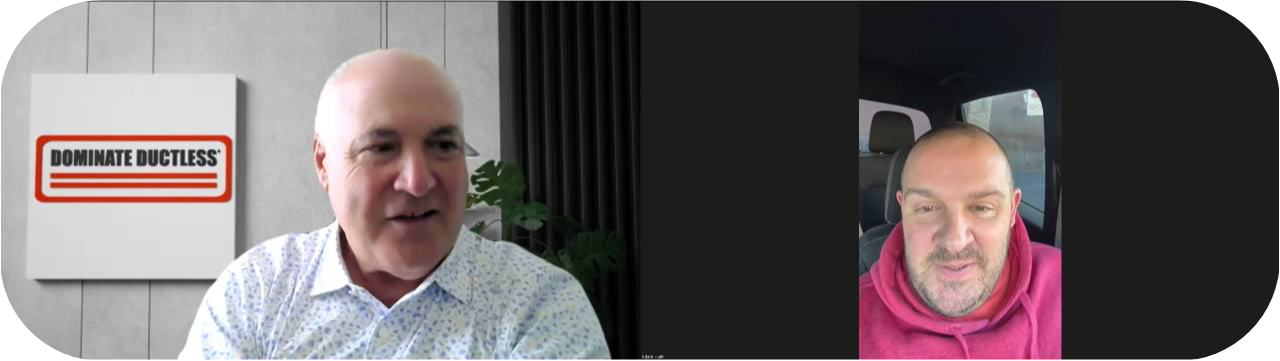
I’ve known Adam Hunt for more than 20 years, and I hired him when he couldn’t tell a wrench from a screwdriver. What he said in that interview is the reason he got the job, and it’s the same reason he’s good at what he does now: I don’t know anything, so teach me and I’ll do it your way. I’ve interviewed a lot of people who came in wanting to tell me what they already knew. Adam came in ready to learn. He also came in with ripped jeans and a mohawk, which he brings up himself in this episode, and I’m glad he did — because it sets up the best answer in the whole conversation.
I asked him what separates the contractors who succeed at heat pumps from the ones who struggle, and he didn’t say training or marketing or equipment. He said leadership. You can teach anybody to install a system. What you can’t hand somebody is the ability to manage personalities, to figure out where each person belongs so they can actually shine. That’s what he says turned his own life around on my loading dock, and it’s what he watches separate his customers now.
The other reason to listen is that Adam is standing in a place almost nobody else on this show has stood. Twelve years on the truck, four years running installation, and now a distributor account manager serving 20 or 30 companies. When he tells you contractors are hesitant about the refrigerant change, that’s not a rep repeating a sales meeting. He knows exactly what it costs to re-tool a truck and retrain a crew, because he used to be the one doing it.
And then there’s the chicken wings story, which every owner listening should sit with. Adam rolls up on a job at lunch, finds two guys eating on the front lawn with zero sense of urgency, on a two-day project he says he’d have knocked out alone in six hours. So he goes to the owner’s house afterward and they run a real job costing report — burdened labor, trucks, insurance, all of it. The owner lost money and had no idea. Two weeks later they ran it again on the next job and he made money. That’s the whole business in one story. It isn’t that heat pumps aren’t profitable. It’s that most contractors have never actually done the math.
Asked what he’s seeing in the heat pump market, Adam’s first word was honest rather than promotional: it’s a little scary.
His reason is a precedent, not a prediction. He remembers the transition from R-22 to R-410A. A lot of contractors were nervous. They didn’t understand it. They thought it was going to be a massive disruption. And in his words, it really wasn’t that big of a deal. Roughly 15 years later, the industry is going through it again and getting the same reaction.
What actually stalled people:
His summary of the mood: a lot of confusion, and a lot of hesitancy about the full-blown switch. It’s less about the refrigerant than about confidence in what’s happening.
The application changed. Mike’s observation, rolling the clock back 20 years: ductless was an air conditioning product. It went into homes as a cooling application. Now it goes in as a heating application, and both of them describe that as a genuine industry-wide shift rather than a regional quirk.
Adam’s own house is the proof point. He has ductless in his home, with a gas furnace still sitting in the basement. He says he’s turned that furnace on maybe three times in the last five years. When he tells contractors that ductless is his primary heat source, they’re blown away — and he’s seeing a lot more whole-house applications because of it.
The buying driver changed too. For a long time in his market the business was rebate driven, with a lot of incentive money in play. What he sees now is closer to an efficiency-driven economy, with dual fuel — a gas furnace and a heat pump coil on top of it — becoming more and more popular. He’s careful to add that ductless is still a thing, and still a very strong thing.
Mike’s corroboration from another market: he’s finding more and more contractors in New Hampshire offering a dual fuel option on every call, which is notable up there because the fossil fuel side is usually propane rather than natural gas.
On training:
On technical support — the part most contractors underuse:
Asked for a contractor who genuinely transformed their business, Adam had two in mind and kept them nameless.
Where they started: predominantly heating. Boilers and rough plumbing. They didn’t even do furnaces. One of the two is a very small outfit — two or three guys — and the owner called simply wanting to know what ductless was all about.
The sequence Adam ran, and it’s worth copying:
Where they are now: he estimates 50 to 60% of both companies’ business has shifted from plumbing and heating to HVAC. They used to have nothing to do in the summer and would send guys off; now they run a full 12 months. The larger of the two recently did all the HVAC on a 14-unit condo building.
His closing line on it: these guys didn’t even know how to spell HVAC a year ago.
Asked what separates the successful heat pump contractor from the one who struggles, Adam said he’d been waiting for the question. His answer was leadership and expectation inside the company.
The core of it: the job itself — the installation, the sales — is not the hardest thing in the world to do. That’s not the hard part. The difficult part for a growing company is the management team learning to manage personalities. You can teach skills to just about anybody, but every individual arrives with their own.
Why he believes it: he tells this to every one of his customers, and to his own daughters. And the example he uses is himself. He remembers rolling in years ago with ripped jeans and a mohawk, not taking the job very seriously — and Mike knowing how to manage that particular personality, get the best out of him, and refocus his life.
What it produces: once you figure out exactly where to put people and how, they shine, and the business takes off. In his framing, it’s about getting to know your people more than anything else. Marketing comes next, and he calls it massive.
Asked what he wishes more contractors understood, Adam didn’t hesitate: the opportunity for profitability.
The ductwork trap. He watches contractors buy endless amounts of ductwork. Ductwork is ductwork — but on a four or five room ranch you’re in that house for a week cutting holes in ceilings and running duct, it’s a mess, and you don’t make money.
Mike’s material-to-labor ratio, which he says he’s demonstrated in something like 500 trainings across the country: if a job carries roughly equal material and labor cost, it is going to be extremely hard to make money. On a five-day job you sell product on Monday and then provide nothing but labor Tuesday through Friday. A profitable model sells boxes every day of the week alongside the labor. His caveat: this isn’t an argument against combining ducted and ductless on the same project, which works very well — it’s an argument for pricing it properly.
How Adam runs the conversation with a contractor:
Mike’s crew-size point, which Adam agreed with flatly: two guys can do a two-zone system in a day, and one guy can install a single zone in about four hours. Sending a two-man crew out for eight hours on a single zone is a waste of money and time.
The chicken wings job. On a project with the smaller of the two companies, Adam rolled up around lunchtime and found the crew sitting out front eating pizza and chicken wings with zero sense of urgency. It was scheduled as a two-day job. He says he’d have finished it alone in six hours.
Afterward he sat down at the owner’s house and ran a real job costing report — line set cover, equipment, and critically the burdened labor rate, including the trucks and the health insurance, not just the hourly figure. The owner had lost money on that job and didn’t know it.
Adam gave him the critical feedback and told him how to approach the next one. A couple of weeks later they ran another job, the crew smashed it, and they did the job costing again. This time the owner made money — and his reaction, in Adam’s telling, was that he could actually make good money at this.
Mike’s summary of what it takes: a burdened labor rate spreadsheet to know what your people cost you, and a job costing sheet with the right margin on it. That’s it. It is not that difficult.
Mike’s training exercise on the same theme: he presents a complete ducted cut-in job in an attic with a three-ton system in summer and asks the room how long it takes. One company will claim two guys can pipe, wire, and finish the whole thing in a day. Another says that’s impossible. It climbs to two days, then three. Eventually one honest company says four to five days with two guys to do it right — because rushing day one means going back on days two through five to fix it.
His advice to a contractor just getting into heat pumps:
Why he’s emphatic about it: his own training as an installer was two days with someone who, in his description, wasn’t a very good trainer. He remembers going out to his very first installation with a keyhole saw to make a hole through a house.
The callbacks he gets, and what causes them. A company installs a system and calls a week or two later with a leak, or no heat, or no cooling. His diagnostic questions are always the same:
The answer is usually no. He’ll pressure the system up with nitrogen and watch it fall, and find a bad flare — often because the crew used an automatic flaring tool instead of a flare block, or skipped the torque wrench when tightening. His verdict: corners cut here and there, work done the old rule-of-thumb way instead of to manufacturer specification.
Both of them land in the same place. Mike calls it lack of training and Adam agrees without qualification. On a single zone you’re connecting four ports and six wires — so the failures come down to leaks or wiring. Adam’s note on the equipment itself: there’s very seldom an actual manufacturer defect, because the units are tested at the factory before they ship.
Adam Hunt has now watched this business from both sides of the counter, and the picture he paints isn’t a boom or a bust. Interest has come off its peak. The refrigerant transition has a lot of good contractors frozen. And underneath all of that, HVAC is the fastest growing segment in his company, nearly every system going out the door is a heat pump, and two boiler shops that couldn’t spell HVAC a year ago are now running more than half their revenue through it.
The gap between those two facts is not equipment and it is not the market. Listen to what he actually names as the difference: leadership that knows how to manage its people, training that happens before the first job instead of after the first callback, and an owner who has sat down and done real job costing with a burdened labor rate. The chicken wings story is the whole thing in miniature — that contractor wasn’t losing money because heat pumps aren’t profitable. He was losing money because nobody had ever shown him the math.
The tools are sitting there. The training at your distributor is mostly free. The tech support line is one you’re probably not calling. And the transition everybody’s nervous about is the same one we survived with R-22, when the sky didn’t fall then either. Spend it getting ready or spend it getting nervous — that’s the only real decision in front of you.
Listen to the full episode in the player above, or listen on your preferred podcast app.




Mike: Good morning and welcome to the Dominate Ductless Podcast, where I share the insights and stories that help HVAC contractors successfully build businesses focused on ductless heat pumps. My conversations are with industry partners and contractors on how you support contractors, industry trends, and practical advice that helps contractors grow.
This morning I’d like to introduce Adam Hunt. Adam is a longtime friend of mine — I’ve known Adam for probably over 20 years. Welcome to the show this morning. Good morning, Adam.
Adam: Good morning, Mike. Thanks for having me on.
Mike: How are you doing?
Adam: All right. Good. I’m doing very good, thank you.
Mike: Very good. So tell the audience, Adam, a little bit about yourself. Just kind of how you started in this industry and where you are today. A short brief.
Adam: Yeah. So my journey really began with Mike about 20 years ago. I was going to the Peterson School for HVAC and came across an ad for N.E.T.R. And it’s funny — my mother actually was the one who called and tried to set up an appointment with Mike. So I came in. I didn’t know the difference between an open-ended wrench and a Phillips screwdriver at the time.
Mike: Wow.
Adam: But I came in and had an interview with Mike, and he had asked me at that time why he should hire me. And I said, because I don’t know anything. And you teach me how to do it, and I’ll do it your way. And the rest is history.
I joined N.E.T.R. and worked there as an installer for 12 years, doing residential ductless and some commercial refrigeration. After about 12 years I moved inside as installation manager for another four. And then my journey kind of took me more on the supply side. So right now I am currently an account manager with the F.W. Webb Company out of Malden, Massachusetts, and just loving the trades and where it has taken me in my life.
Mike: That’s an interesting story. I mean, you really helped me grow my business immensely. You were a strong partner that really helped me get where I needed to get. And you had a lot of great ideas. I personally want to thank you for that, too. So what does your day-to-day role look like now? What do you do now?
Adam: So my role is really just working with different contractors, different companies, going out and seeing how I can best serve them in terms of providing training, providing product, providing any kind of information on the industry — what’s coming down the pike. Really just trying to make their business run as efficiently as humanly possible.
When I was working with you, we were doing that with one team, and that was fantastic. And I grew so much from that. And now I have the opportunity to kind of do that with 20 or 30 different companies, where I feel like I’m a member of those teams as well. It’s such a great feeling at the end of the day to know that I have an impact on all those people.
Mike: What does your company do to support contractors now? How does that role work? Can you give me a little insight into what your distributor, what your company does?
Adam: Yeah. So what we do is we provide an endless amount of training. Recently it’s been real heavy with the A2L transition from R-410A over to R-32 and R-454B. So we’re constantly providing training at all of our different locations. We come out and we will work with contractors in the field or actually at their office and try to help them develop their business and their purchasing habits — and really just bringing this newer generation of technicians out in the field up to speed with the new technologies and the new regulations that are in the workplace.
And then providing lots of different options in terms of products, stuff like that. So we’re just very, very hands-on with the contractor. And in my particular role, I get to be really the face out in the field, touching the contractors personally.
Mike: That’s really good. So let’s talk a little bit about the heat pump market right now. What are you seeing out there in the heat pump market? And how’s the contractor interest — still high, low? Tell me a little bit about what you’re seeing with the heat pump market today.
Adam: Yeah. So to be honest with you, it’s a little scary. And the reason why I say that is, I remember when we transitioned from R-22 to R-410A, and there were a lot of contractors that were real nervous about it. They didn’t understand. They thought it was going to just be this massive disruption in their business. And it really wasn’t — it wasn’t that big of a deal. And now, fast forward 15 years, and we’re kind of going through it again.
Initially there was a real big holdup with R-454B specifically, where you couldn’t get it. And there were these hard cutoff dates where R-410A equipment was no longer going to be produced, and then there’s sell-through periods. And these contractors had no idea what to do. They were real hesitant to switch to the new A2L refrigerants. And then when there was a shortage of gas, that exacerbated it even more, where they were like, can we just keep with the R-410A? Real hesitant to make that switch.
And I know that the EPA is having some conversations now about extending the installation period for R-410A equipment. So there’s just a lot of confusion, I think, and a lot of the hesitancy with some of these guys in making that full-blown switch — that they don’t want to buy all new gauges and all new equipment. And it’s a little scary in terms of their confidence in what’s happening.
And then we’re also seeing a slight shift where, for a long time, it was rebate driven. There was tons and tons and tons of money out there. And now it seems it’s almost like an efficiency-driven economy, where guys are really going for that dual fuel system where they put in a gas furnace and then a heat pump coil on top of it.
So ductless is still a thing. It’s still a very strong thing. But yeah, I’m just starting to see a little bit of a shift from rebate-driven installations to efficiency-driven installations, and dual fuel applications becoming more and more popular.
Mike: Do you think the contractor interest is still extremely high in heat pumps, or do you think that’s settling down now? Do you think there’s still room for a lot of growth with this? Or do you think this has kind of peaked out? What’s your feeling on that?
Adam: I don’t want to say that it’s peaked out, but I think it has slowed down just a little bit — slowed down just a little from, call it, ten years ago. Ten years ago this thing was the biggest, fastest, shiniest object. And I think it’s starting just to slow down just a little bit. It’s not gone. It’s not going away. I don’t think it’s going to go anywhere.
Mike: Have you seen — if you were to look back at 2025 sales… I know you worked for a previous distributor prior to coming to this distributor, but do you think sales of heat pumps are up overall in the company? Or do you think they’re flat? Or is there room for growth still? Where do you go? You guys work with a lot of plumbing outfits too that are getting on board with this. What are your thoughts on this?
Adam: There’s definitely been a growth, I know, within my current company now, and with my previous employer. At my old company, we had zero sales in HVAC when I got there, and it started to really take off. I know here our HVAC growth is well over 15% from last year. It’s our fastest growing segment in my current company.
Mike: Yeah. Wow. You think that is — is that heat pumps? What part do you think heat pumps play in the whole overall HVAC growth section of that?
Adam: Massive. Massive. I mean, the amount of systems that are going out that are unitary, AC-only type systems — it’s few and far between. The old loud boxes on the side of the house, that has shifted very far away. And heat pumps — it’s like every single system that’s going out the door right now is a heat pump, whether it’s ductless or whether you have an air handler, the ducted ductless versions, if you will. But no, heat pump technology is definitely the front runner in our growth within the HVAC trade, for sure.
Mike: That’s interesting, because I was talking to a contractor the other day who was up in New Hampshire. And I’m finding more and more contractors in New Hampshire where there’s always a dual fuel option that they’re offering. And I find that amazing, because it’s usually propane up in the mountains and places like that. There’s always a dual fuel option with the heating side.
And I find it funny how heat pumps — the ductless heat pump part of this. When we first started doing this, roll the clock back 20 years ago, it was more air conditioning, right? It was always an air conditioning application. And now I see this big shift, and now it’s more of a heating application. I find it kind of funny that it started out as this and now it’s gone to that. But I think there’s just been a whole big market and industry shift in that.
Adam: Oh, totally. Yeah. I mean, just me personally, in my house I have ductless. That’s how I heat my house. I have a gas furnace still in the basement, and I’ve bumped it on maybe three times in the last five years. I just don’t use it.
Mike: Yeah.
Adam: When I tell guys this, I’m like, yeah, this is how I heat my home. This is my main source of heat in my home. They’re just blown away by it. But it’s becoming more and more popular, and you’re seeing a lot more whole house applications for sure.
Mike: Do you think that some contractors still have misconceptions about heat pumps?
Adam: Yes.
Mike: You really think so, huh? Where do you run into that?
Adam: Where I run into it is on the plumbers. I hate to say it, but—
Mike: I can see that, because they’ve been dealing with wet heat their whole life.
Adam: Right. I mean, they’re used to radiators and, especially in this area, big steam boilers. And they’re like, there’s no way that little piece of plastic on the wall is going to heat your house. It’s just not going to happen. And they’re very skeptical about it, for sure.
But the more exposure they have to it, and the more you have somebody like myself where I go out and talk to these guys and kind of educate them on what the technology can actually do — it’s becoming more and more, like I said, it’s our biggest growing part of our business right now.
Mike: Yeah, I think they see it too. I mean, I’m not positive on this because we never did a lot of plumbing, but I would think the heat pump side is possibly more profitable than the plumbing side. I just see a lot of moving pieces to plumbing when you’re doing boilers and things like that. But I’m not positive on that, that’s not my role. What do you think about that? Have you gone through that exercise with a plumber?
Adam: Yes, I definitely have. I’ve been on some boiler installs.
Mike: Okay.
Adam: And the reality is, when you see the term HVACR, right?
Mike: Yeah.
Adam: There’s the H, and that’s the heating part of it. And I would always get confused as to why there’s heating and plumbing, and heating, and then there’s HVAC, and what the big difference was. And the reality is it’s two totally different trades. Two totally different ways to heat your house. The plumbers think the HVAC stuff is really complicated and confusing. And then the HVAC guys look at the boiler and say, what the hell is that thing? It’s just two totally different trades. The training is totally different. The schooling that you have to go through for that is totally different.
So it’s just not being familiar with the other trade. That’s really all it is. Neither one is any more complicated than the other.
Mike: So I would say that’s probably one of the biggest challenges that you have when you go out and you try to talk to a plumber about adding heat pumps to their business. Is that the biggest challenge you face, you think?
Adam: Yeah, I just have to explain to them — water and refrigerant. It’s mechanical equipment that’s either moving hot water or steam versus moving refrigerant through a system.
Mike: What resources does your company provide for training and technical support for that? Because you’re trying to switch them over now, you’re trying to talk to the plumbing industry a little bit about heat pumps. How does your company provide training for that? What do they do? What type of support do they have? What type of marketing do they have? How does F.W. Webb do that today?
Adam: Yeah. So all of our vendor reps are fantastic. They come in. Me personally, I just sat in on a ductless and heat pump class yesterday. So they’re really, really big and really strong on training for its employees — inside sales staff, outside sales staff, even counter and warehouse on proper ways to handle the equipment.
And then there’s multiple branches all along from New Jersey all the way up to Maine, and different manufacturers’ reps along with the individual companies. I mean, there’s trainings going on all day, every day, different locations. We’ve got low voltage control wiring, there’s heat pump, there’s A2L, there’s cold climate training, boiler training — I mean, you name it. If we sell it, we have somebody here that will come in and train whoever needs the training on it, free of charge in most cases.
It’s really just supply and demand. If we have customers that want to get trained up on something and we feel that it’s a product that we want to stand behind, we will put on trainings in multiple locations.
Mike: How does the technical support work for these guys? Is it through manufacturers, or is it through you guys? How does that work?
Adam: So within Webb we have a very, very strong in-house tech support team. I work very, very closely with them. There’s maybe a dozen just up on the East Coast, where if it’s heat pumps, if it’s HVAC, if it’s plumbing, we actually recommend that the contractor call us first and go through our technical support team, our service team, before ever escalating it to the manufacturer.
We have good standing with a lot of our vendors, where if we diagnose something — just as an example, if we say okay, there’s a bad condenser fan motor in a condenser, and we can diagnose that — our manufacturers will stand behind us. They trust us that that’s what it is, and the warranty process goes through us. It’s seamless. It’s super, super simple for the contractor.
Mike: And have you really seen, in your journey on the distributor side, a success story you could share about a contractor who transformed their business? Do you know of one that you’ve seen that has really done a transformation?
Adam: Yeah, yeah. I have one in mind, now that you bring it up — one of my current customers. I’d like to keep them nameless at this time.
Mike: That’s fine, that’s fine.
Adam: But they were predominantly heating. That’s really all they did was heating. They did boilers. They really didn’t even do furnaces. It was just mostly boilers and plumbing, rough plumbing. And they had—
Mike: A profitable business, but anyway.
Adam: No, no. They had called up and they were interested in getting into ductless. It’s actually two different companies I can reference. One of them’s a real, real small company, small outfit, two or three guys. And he just said, what is this all about? I’m super, super interested in it.
And I went out and I brought his guys in, his whole company, and we went through a training similar to the training that you put on, that you and I worked on together at N.E.T.R. I trained his guys in-house at first, and then I had a manufacturer come in and provide supplemental training on the actual product — because I can teach the installation portion of it, but I wanted them to get familiar with the product itself and get certified through the manufacturer.
Once we got that done, I went on site with them and assisted — hands off, but I assisted with an installation. Kind of talked him through the whole thing, walked him through the whole thing. And then I did it again the second time. But the second time I went, I kind of kept my mouth shut. I stepped back and just let them do their thing, and served as an advisor.
And now both of those companies, I would say 50 to 60% of their business has shifted from plumbing and heating to HVAC. Specifically in the summertime — where they would send guys off in the summer, they would… I mean, with us it was kind of in the winter months, but with these guys, they were taking the summers off because they had nothing to do. And now they’re full 12 months, and HVAC is a major, major part of the business.
One of the companies, the larger of the two, they just put in — I think it was a 14-unit condo building — and they did all the HVAC for it. And these guys didn’t even know how to spell HVAC a year ago.
Mike: What separates a successful heat pump contractor from those who struggle? What do you think happens? What separates those guys from the ones that are struggling? Because a lot of guys want to get into it, they want to do it. What separates the successful ones?
Adam: I was thinking about this. I was waiting for this question. It’s the leadership. I hate to say it, and I don’t want to just generalize it, but it’s the leadership within the company, and the expectation.
And I learned a long time ago — and this is something that I tell every single one of my customers, I tell everybody, I even tell my daughters this — the job itself, the installation, the sales part, it’s not the hardest thing in the world to do. It really isn’t. That’s not the hard part.
The most difficult part for a company coming up is when you have your management team, it’s learning how to manage personalities. That’s really the thing that has stuck with me, and that has helped me immensely. Because you can teach skills to just about anybody, but each individual person, they’ve got their own personality.
I remember rolling in a long time ago, and I remember you were standing on the loading dock, and I had ripped jeans and a mohawk going, and I didn’t really take my job very seriously. But you knew how to manage my personality, and to get the best out of me, and to kind of refocus my life.
Mike: Yeah.
Adam: And really, it was that shift. And when I kind of took over, it was like — you can teach the skills, like I said. But managing the personalities of the people that you’re asking to do the projects, that’s when you can really tap into the skills and the knowledge that your employees have. And once you start to figure out exactly where to put people, how to put people, they can really shine and your business will just take off. But it’s really getting to know your people more than anything else. And then to go with that, marketing is massive.
Mike: What do you wish more contractors understood about heat pumps or your products? You go out every day and you see these guys. If you had one thing to say — what do you wish that they could understand better about heat pumps?
Adam: The profitability. The opportunity for profitability you can make.
Mike: Boy, am I glad you said that.
Adam: I see these guys come in and I talk to them, and they’re buying just endless amounts of ductwork. And okay, ductwork is ductwork, but you’re not going to make money. You’re just not going to make any money. If you had a little ranch, like a four or five room ranch, you’re going to be in there for a week cutting holes in ceilings and running all this ductwork, and it’s a mess. You don’t make any money.
Mike: I’ve demonstrated that a million times. I’ve probably done it at least 500 times in 500 trainings across the United States. And I see guys wake up to it a little bit. But I think probably the biggest way to get it across to them — I know where you’re going — it’s definitely material to labor ratio.
When you look at those two numbers and you see I’ve got $5,000 of material and $5,000 in labor cost to do this job, I’m just telling you right now, that job is not going to make money. It’s going to be extremely hard to make money. Because if that’s a five day job and you’re going in there Monday and ending on Friday, you have only sold the product on day one. The rest — Tuesday, Wednesday, Thursday, Friday — you’re just providing labor. You’re not selling material.
And I think a good way to get that across to the contractor is: look, if I can sell boxes on Monday, Tuesday, Wednesday, Thursday and Friday along with labor, that’s going to be a profitable model. And I think it’s just so hard to get that across, because I agree with you, they’re so entrenched in this ductwork thing.
And look, I’m not saying don’t add ducted and ductless together, because those projects work very well.
Adam: Right.
Mike: Right. But make sure it’s priced properly. And I think we just rolled into the section that I wanted to talk about, which was business and profitability. I think stressing it to contractors that heat pumps are profitable — they really, really are.
So what do you tell contractors about the profitability on it? I think that’s the best part to talk about. How do you talk to a contractor about profitability with heat pumps who’s not doing it at all right now?
Adam: Right. So I’ll go in and I’ll talk to them about how long it would typically take them to do a boiler, or just a unitary system with ductwork or whatever. And we’ll start talking about ductless. And once we get past all the training aspect of it, and they understand what they’re doing and they know that there’s a process to this whole thing, I say, okay, now that you know how to do it, let me come look at a job with you.
And we’ll go and we’ll look at a project and I’ll say, okay, this is going to be two days. You’ve got a lead and a helper for two days. Go. And they go, oh no, I had this for five. No, no, no. Two days. And this is the number that you should be around.
And I tell them, and they’re like, yeah, but that puts X amount of dollars in my pocket at the end. Yeah, I know exactly what it puts in your pocket. You need to do this, and you need to do it on a regular basis. And once you start doing this, you’re going to start to build this muscle memory. Okay, this particular project takes these two guys this much amount of time. And then you can start to really push on your marketing, and you’re selling, and you fill up a schedule.
Mike: You know, we had a — I had a magic Excel spreadsheet, and that thing just had colors and names.
Adam: Selling boxes, right?
Mike: It was unbelievable. Just like playing chess.
Adam: It turned into just an absolute machine. And yeah, it’s insane if you know what you’re doing. You market your company, you get out there, you sell, and then you have a good install team that can go out and install the product that you’re selling. You fine tune all those little things, and it just becomes a machine. It’s unbelievable.
Mike: I have one contractor in Chicago. He’s one guy, one owner, with two install crews. And he does $2 million a year with five people. And his focus is on heat pumps. And he says, hey, there might be a day I don’t have a job here and there, but that’s okay. He said, I have enough money, I can pay my people to not even work today. He said, because this is what I do and I’m extremely profitable at it. When you look at it, the heat pump market, I feel, is extremely profitable.
And what do you tell guys that say, well, it’s going to take me five days to do this job? When I look at heat pumps, there’s a total misconception, I think. Even when I teach my class and I show these guys — you’ve got a two zone heat pump that you’re doing today, two guys can do that in one day. One guy can install a single zone unit in four hours. Am I right or wrong?
Adam: 100% right.
Mike: And I see most crews — do you see this a lot, that most companies are so attuned to sending out a pair of people to do a job? Do we need two guys to go out for eight hours to do a single zone heat pump?
Adam: No. Absolutely not.
Mike: And that’s just a waste of money and time. Am I correct?
Adam: Totally correct. Totally correct.
Mike: And how do you get that across to these guys? Because they’re so entrenched in the two man crew, and Billy and Bobby driving around, and it’s just a loss of revenue.
Adam: So what I had done with the previous companies that I was talking about — the smaller of the companies. He’s a real small company, so he can’t absorb these massive costs, especially with labor being the biggest expense that you’re going to have.
I did a project with them, and I remember I rolled up onto the site around lunchtime, and his guys were sitting out front just eating pizza and chicken wings, and there was zero sense of urgency at all. Like none. And he had scheduled it for a two day project. And not to bolster anything, but I would have had it done by myself in six hours. And they had two guys there for two days, and these guys are just hanging out on the front lawn eating chicken wings.
Mike: Oh, God.
Adam: When it was all done, I went to his offices at his house, and I sat down and I go, let’s do a job costing report on this thing. And we sat down and I went, all right, let’s talk about your expenses. I want to know, how much did you spend on line hide? How much did you spend on equipment? And what did it cost you in labor — and not just their dollar figure, the burdened labor rate, because they have trucks and they have health insurance and they have all of that. Really do a deep dive job costing on that job. And I’m just telling you, I could have done it by myself in six hours if I was working for you.
And let’s just do it. And after he did all of the math and we sat down, he lost money on that job. And I said, this is not profitable for you. You don’t get it, you don’t understand. So on the next one — this is some critical feedback that I’m going to give you here — this is how you should really approach this one.
Mike: Yeah.
Adam: A couple weeks later he does another job. They smashed it. They did a great job. And I go, all right, let’s do another job costing. Let’s figure this thing out. And he actually made money, and he was like, holy crap, I can actually make a good amount of money on this.
Mike: Pretty simple. Because all you need is a burdened labor rate spreadsheet to figure out what my people cost me, and a job costing sheet that has the right margin on it. It’s not that difficult. It really is not.
I see it all the time. I go through these exercises in training, and these guys throw out these labor numbers. You’ve got to see the one that I do with a complete ducted cut-in job in an attic with a three ton system in the summertime. And I have a company that will tell me they can put two guys out there for one day and install all the ductwork and get the whole entire job done — piped, wired, everything.
And then I’ve got another guy saying, what? Are you out of your mind? There’s no way. Then it goes to two days with two guys. Then it goes to three days with two guys. And then I usually have one honest company that will stand up and say, guys, this is a four to five day job with two guys to do it right. Because if you rush the first day, you’re going to be back the second day, third day, fourth day and fifth day fixing all the mess-ups that happen. And then now we start to look at the labor side of it, and exactly what you just said. Now they grasp it and understand it and go, wow.
I guess if I ask you this one — what advice would you give to a contractor who’s just getting started in the heat pump business? What would you tell him?
Adam: Educate yourself first. Get trained. Understand what you’re doing. Take a chance. If you’re going to do this, if you’re going to get into ductless, just commit to it.
I stress the importance of training. My training as an installer consisted of just two days working with a guy who wasn’t a very great trainer. I remember my very first installation, I went out there with a keyhole saw to try to make a hole through a house.
But either way, getting the proper training and understanding what you’re doing, having some confidence in yourself that you’re going to do this thing and you’re going to do it right — commit to it and just take a chance on yourself. If you really believe in yourself, take a chance on yourself. Learn. Just ask a lot of questions to people that have been doing this for a long, long time. If somebody is offering training, go to the training. Really, really know what you’re doing before you get into it.
Don’t just be like, well, I’m a plumber, and Mrs. Jones bought a unit from a big box store and wants me to come hang it. No, no, no. You’re going to do it, do it right. Be a professional. Do it right.
Mike: What are the common mistakes they should avoid?
Adam: For the new companies coming up?
Mike: Yeah, for a new company coming up. What are some of the common mistakes that you feel they can avoid right out of the gate? I guess, what are the biggest mistakes you see happen on jobs with guys that are just starting out? You’re always getting that call from somebody. What are these common mistakes? You probably see them all the time.
Adam: Yeah. The biggest thing that I’m seeing is companies will go in, they’ll install a system, and then a week or two later they’ll call me and they say, we have a problem. What’s the problem? Well, there’s a leak. There’s no heat, or no AC, two weeks after.
And I’ll go out to them and I’ll say, okay, did you do a pressure test? Did you do a triple evacuation? Did you weigh in the charge properly? Did you measure? Did you do a — oh, no. Okay.
Mike: That’s your biggest mistake.
Adam: There’s your problem. And then I have nitrogen and stuff, and we’ll bump it up and we’ll get it up to four or 500 psi, and sure enough it’s starting to go down. And you look, and I’ve got a bad flare because they tried to use some fancy tool that they bought that automatically does the flare, instead of using your trusty flare and block. They just try to cut corners here and there, and they’re not doing all of the steps really to the manufacturer’s specifications. They’re just kind of doing it rule of thumb, old school way of doing stuff. And it doesn’t work. No torque wrenches when they’re tightening flares.
Mike: Look, they give you a torque spec. Sounds like lack of training to me.
Adam: Yeah. Lack of training. That’s it.
Mike: Lack of training is the common mistake. And let’s be honest, it’s usually two things. It’s either leaks or wiring. Because really, you’re only connecting four ports and you’re connecting six wires. If you’re doing a single zone, you’re connecting four ports and six wires. Correct?
Adam: Well, yeah. Now there’s an extra wire, but—
Mike: Whatever it is. But what we’re saying is, it’s really cross wiring and leaks.
Adam: Yeah. That’s it. There’s very seldom an actual manufacturer defect. These things are tested in the factory, soup to nuts, before they go out in the field.
Mike: All right, so let me ask you this, kind of in closing here — just support and resources. How can contractors connect with your company? How do they do that? How would you go about it if you’re not already doing it?
Adam: So if you’re not doing it — we are the big giant red box that’s almost all over Massachusetts and New Hampshire and Connecticut. Our website is the landing page for our company. If you don’t have an account, it’s like three clicks and you can apply for an account to get an account with us. All of our contact information is there.
I think, Mike, you might have my contact information — you could throw it up on the screen after this. You can call me. We are 8,000-plus employees, so we’re all one team. We’re all one company. We’re all here to help each other and to help you. You can’t miss.
Mike: Any upcoming events, launches or initiatives that contractors should know about that’s going on with heat pumps, or anything you’d like to add?
Adam: I don’t have anything right now. Right now we’re kind of shifting into — I hate to say it, because this is the Dominate Ductless podcast — but it’s boiler season. And really, within this company that’s been the bread and butter. So there’s a lot of boiler training going on right now. There’s some furnace trainings coming up.
On our website, again, right towards the top you’ll see a Careers and Training tab. You can click on trainings and you can see a list of all trainings for all locations. You can filter it by whatever state you’re in. If you go up to New Jersey, it’s all there.
And really, just by reaching out to any one of us — if you have a request, a comment, a question, a concern, if you’re interested in getting trained on a particular product, you can reach out to any one of us and we can get the wheels in motion to get you and your company either trained at one of our locations or right there at your shop. Again, it doesn’t matter what state you’re in. If you’re down in Jersey, New York, we’re in Pennsylvania, Maine, New Hampshire, Vermont, Connecticut — we’re everywhere. So yeah, we’re here to help you.
Mike: Well, hey, thanks for joining the Dominate Ductless podcast this morning. This has been really, really good. I always enjoy catching up with you. And as always, thank you for everything you’ve done. Say hello to the family, and keep knocking them dead out there, kid. I’m very proud of you. I’ve seen you come from a guy who knew nothing to a guy who knows a lot right now and is very valuable to the industry. So again, thanks for coming on.
Adam: Thank you again for everything, Mike.
Mike: Thank you. Take care.
