If you would like to be a guest on my podcast to share your take on the opportunity that ductless heat pumps offer today’s HVAC contractor, please drop me a note at info at dominateductless dot com or click here to send me a note through my contact page.
Paul Bojko owns A-Guy Heating & Air in Palos Hills, Illinois, and he didn’t come up through the ductless trade. He came up through remodeling.
Paul started the company in 2017 doing repair and remodeling with just enough HVAC on the side to keep the phone ringing. Then in 2019 he sat through a two-day class I taught in Schaumburg, and by his own description, the light bulb went off completely. He had no idea the product was that big, or what kind of money he could make with it.
He dropped the remodeling side entirely and never went back.
Today, mini-splits and ductless run about 80% of his business. He finished last year up 30%. And other contractors in his market call him for sizing help, then hand him the jobs they don’t want.
In this conversation, Paul walks through why he rebranded before he grew instead of after, what a market that has never heard of a mini split actually costs you in sales time, the eighteen-month reality of SEO, and the one thing he still puts off that he knows he shouldn’t.
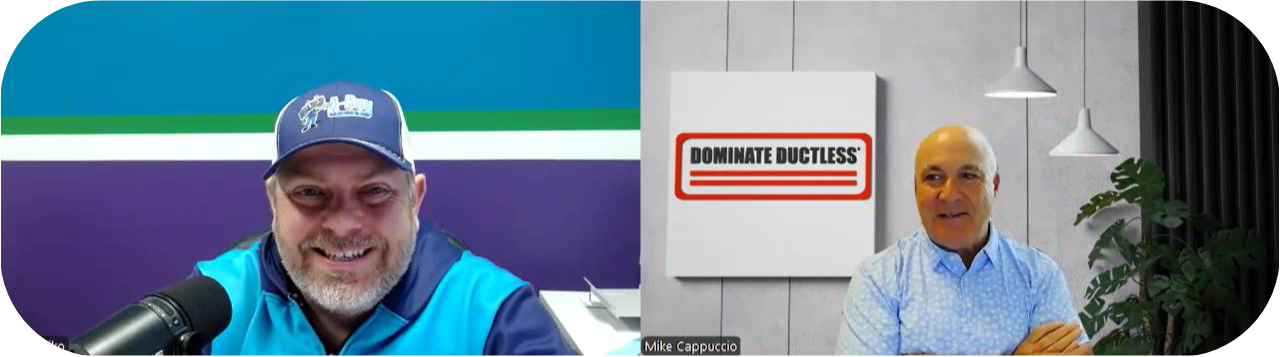
His reasoning, and it’s the part worth stealing: he wanted the foundation set now so he could build the company on top of it, rather than spend ten or fifteen years growing and then have to think about branding after the fact.
What gave time back: he took my push to use AI seriously and now uses it to streamline. Things take less time, he has more evenings with his family, and the stress level is down.
My note on the video discomfort, because it’s universal: I’ve watched Paul’s first videos and I’ve watched his current ones. Everybody is stiff and uncomfortable on the first few. Then you do a few more and it goes away. What I tell every contractor is the same thing. Relax, be yourself, say what you want to say, and get the point across. Authentic video is extremely strong in today’s market.
4. Filling the Funnel: Video Before the Front Door
Asked to name a single coaching change that moved the company, Paul said there were too many to pick from, then picked one anyway: starting the funnel. It comes down to marketing, and specifically to video, getting customers interested in the product before anyone is in the room. The whole relationship started from one question: we need more customers, how do we get them?
How he uses the video now: when he sends an email, he includes links to the videos and sends them directly to the customer. Before he ever gets to the door, that homeowner has seen who he is, what the product is, what it looks like, and a testimonial from another customer.
The path he sends people down:
Case study content on the website has been a significant part of the build. When we first met, there wasn’t much educational content there at all.
My addition on calls to action: video is powerful, but it’s only as good as what it points at. The best call to action in almost every video is learn more, and then you have to have actually built the place you’re sending them. Drive them to social, drive them to a learn-more page, let them understand how the thing works and what it will look like in their home. These people have a problem. You’re showing them the solution.
5. Want Versus Need: Why Heat Pump Businesses Are Different
My framing, and Paul vouched for it: a heat pump is not a need product. Nobody wakes up needing one today. Think about the problem room, the space that’s been uncomfortable for years. The homeowner wants a solution, but they don’t need it this afternoon, and the job is moving them from want to need to installed. That’s true of whole-home dual fuel and everything else in this category, which is why the funnel has to stay full and the education never stops.
Paul’s version of the same problem, from the field: East Coast, West Coast, and down south, homeowners already know what a mini split is. In the Midwest, he says, people have no idea, and the sales process is that much slower for it. His example from the day before we recorded: a customer with an air handler in the attic that physically wasn’t going to fit going back in after a redesign. He raised mini splits and she said she’d never heard of it, which he says is the majority response.
So the call goes into education mode: how it operates, where it goes, what the bells and whistles are. The line that enables it: ask whether they’ve ever seen those boxes on the walls while traveling internationally. Almost everyone has, and almost everyone liked them.
Why it fits his market specifically: the region has built a culture around ductwork, and in his area the ductwork is poor, static pressures too high, retrofits difficult. Ductless is genuinely the better answer in a lot of those homes, not just the easier sale. Where those conversations land: a lot of his customers end up on a dual fuel Intelli
HEAT system. He believes the hybrid approach works best in his climate, and once homeowners understand the technology exists, they lean toward it.
6. Competitors Now Call Him, and Hand Him Work
Asked what his competitors did as he took the market, Paul’s answer was that people basically consider him the ductless guru of the area. Multiple contractors call him with questions: will this work, how does this size, what have you done in this application. They also throw him business outright, jobs they consider too big or too complex. The example: a multi-zone with an Intelli
HEAT system, close to $40,000, from a contractor who simply didn’t want it. His distributor has recorded with him and wants to hold him up as the example in the market.
What that costs to earn: it isn’t a personality trait. It’s the branding, the site, the case studies, the video, and the search work all compounding until you’re the obvious phone call. Paul became the answer to a question his market didn’t know it had.
7. SEO Is Eighteen Months, Not Eighteen Days, and Now AI Reads the Same Signals
Paul says the thing he understood least before doing it was search, and specifically how long it takes. His timeline, from experience: about eighteen months, if not more, before the results got genuinely big.
Why contractors quit early: everyone is conditioned to instant results. The Amazon package shows up in a few hours. Search doesn’t work like that, and people will promise you it does. It has to be part of the job every day, not a line item you pay for and forget.
My side of it: I don’t call it search engine optimization anymore. I call it search excellence optimization, because it keeps getting harder. You need a YouTube channel. You need social presence. You need to be building pages and doing things with your site. I look at an enormous number of contractor websites that were built once, put up, and left, on the assumption that a website by itself changes a business. It doesn’t. And if you’re paying somebody a few hundred dollars a month and seeing nothing, you already know what that is.
Where Paul takes it next, and this is the current stakes: homeowners are now asking AI tools for contractors in their area. If you aren’t ranking, you aren’t getting surfaced, and you already know how that story ends. He’s also had a meaningful number of customers find him organically and turn into work, which is how he knows the back-end effort is real.
The proof point he’s proudest of: over the summer, in a market that doesn’t know what mini splits are, people found him to service units. Not to buy, to service. That only happens when your presence has actually been built. His own team noticed the shift too. The guy who’s been with him for years told the newer guy that this is not normal, because February is supposed to be slow.
8. The Manpower Math: One Guy, One Day
This is where Paul and I always end up, and he confirmed every piece of it on the record.
His caveat, and it’s a good one: A-Guy works on the premium side. They don’t slap a unit on the wall and call it a day. They excavate, lay crushed gravel, and set a pad and stand. That takes longer than running a couple of lines, and it should. The only genuine two-person moment: lifting the unit onto the stand. That’s roughly five minutes of a second body, not a second full day.
Why I keep hammering this: the hardest thing to find in this trade is manpower, and we waste it constantly. I have contractors sending two guys out for sixteen to twenty combined hours on a job that runs five or six. Here’s the exercise. If you’re an owner and you sent two people out at seven thirty or eight, drive by at eleven and look at what’s happening. Every guy who’s actually done it comes back and tells me it was an eye-opening moment.
9. Go All In, or Get Out of the Way
I asked Paul what he’d tell the dabblers, the contractors who treat heat pumps as a side item. His answer, which he’s given on camera for his distributor before: if you don’t want to do this, that’s fine. He’ll take all the business, and it doesn’t hurt his feelings one bit. Stick with your unitary work. The market is huge and he’ll gobble it up.
And for the ones who are serious: go all in. His read on the direction of the industry is that everything is going to be a heat pump. Whether it’s unitary or ductless, the difference is a reversing valve, so why not let the customer heat the home with the equipment they already bought for cooling, especially in the shoulder seasons?
On what he’d tell himself on day one: there have been long hours, a lot of sweat and some tears. Stick with it. There is money to be made.
He also notes, half joking, that he now travels for HVAC more than he ever has, dealer trips, conventions, and events he’s asked to attend, roughly every other month. His line for it: he has a friend who likes to say insurance is gangsta. Insurance isn’t gangsta. HVAC is gangsta. Ductless is gangsta.
His stated next goal: to be the premier ductless contractor across his market, the only one anybody calls. He also hinted at something in the works he wasn’t ready to talk about yet.
10. On Coaching, and Why He Says Yes
His position: if a contractor is trying to grow and reach the next level, absolutely get a coach. You don’t know what you don’t know, and that was exactly the situation between us. There were things he says he’d never have known existed without those conversations, and they moved real money into the business.
His argument by analogy: we have coaches for every sport. We have mental coaches. Why not a business coach? Somebody who’s already been out there, knows what works and what doesn’t, and made the mistakes so you don’t have to repeat them.
My own first mistake, since he asked: I started out as a commercial contractor chasing money every single day. What changed it was listening to a husband-and-wife team from California explain that a ductless heat pump could go in inside a day. I sat there and thought they were full of it, the same reaction Paul had, and then I went home and changed the entire business model. Away from commercial, residential and new construction, toward getting paid the day the work was done.
Paul’s caveat, which I respect: he’s a firm believer that the trials matter and he wouldn’t be where he is without them. He uses his first-grader learning arithmetic as the example. The kid saw a calculator and his eyes went wide, but you don’t hand him the calculator until he understands the principle. Running a business is the same. You make mistakes, you learn, you adapt, and that’s what separates flourishing from failing.
And his closing thought on job security: whatever else changes, AI is not going to install these things.
Listen to the full episode in the player above, or listen on your preferred podcast app.




Mike: Good morning, everybody. Mike Cappuccio here. Welcome to the Dominate Ductless Podcast this morning. And this morning I have a good friend of mine — not just a contractor, but someone I’ve known for a few years. I’d like to welcome Paul Bojko to the Dominate Ductless Podcast. Paul, good morning. How are you?
Paul: Morning, Mike. Thanks for having me on.
Mike: Oh, thanks for coming on. So Paul, let’s give the audience a quick intro about yourself — how long you’ve been in business, and how you got into this whole HVAC racket.
Paul: Yeah, you’re right. It’s definitely a racket. What wound up happening was, I started my company back in 2017 and I was doing remodeling and repair with a little bit of HVAC. Just enough to get some business going. I didn’t have a clientele base. I just wanted to get my name out.
And then right around 2019, 2020, I started really focusing in on the HVAC and did a full transition — went strictly heating and cooling and dropped the whole remodeling repair service. And we haven’t looked back since. Business has been great. I’m glad we made the transition. That was always the main focus. But here we are, plugging away.
Mike: That’s great. That’s great. So what really made your transition into the HVAC side versus the remodeling side? There was something that happened there.
Paul: Yeah. It was this guy named Mike Cappuccio. You know, he got me steered toward ductless systems.
Mike: So let’s talk a little bit about that, because what we really want to tell the audience today is that you and I have been working together now for a couple of years. And there’s some good days, there’s some bad days, there’s some tough love days in what we do. What I really want to get across to the audience is how you put this into your business.
Where were you, I guess, when you said I need to get some help in my business? Something triggered it, or there was a point where we met, or something happened. Can you explain that to the audience?
Paul: Yeah. So it was the light bulb moment, right? When we first met, it was back in 2019, 2020, when we had that Trane and Mitsubishi merger. And I was an American Standard dealer at that time. And when you came in, you did a training there, right?
So back in 2019, American Standard and Trane wound up partnering with Mitsubishi. And when they partnered with Mitsubishi, they had contractors that they wanted to get involved with the product. And so you came in, Mike, to teach a class in Schaumburg, Illinois, and I was a part of it.
Mike: Okay. I remember this training now.
Paul: Yep. And so it was a two-day class. And as I sat in there, the light bulb just started going off completely. I didn’t even realize that this product, first off, was such a hit. Coming from the East Coast, you’d been working on this product for years. This was something relatively new to us in our area, and I just realized how much money could really be made off of this.
And so from that point on, I’ve just been indulged with focusing in on mini splits, or Mitsubishi, or ductless, or something along those lines — trying to be more of a premium contractor as opposed to just these guys that are swapping out boxes. Just doing the same old thing.
Mike: Right. So you leave this training, right? And I see that you went into, like, a branding mode at that point. I look at your trucks, I look at your company, and I mean, I know what you do. What got you thinking? Because the wheels got spinning at that point. When did all this branding take place, and what made you decide that you needed to do all that?
Paul: You know, that’s a good question. So I was following some people online, right, trying to get some free advice. It doesn’t hurt to do your research, listen to people, follow their podcasts.
Mike: Always be listening to people smarter than you. That’s what I always say, right?
Paul: Exactly. There’s so much you can pick up from them, right? And so I was just listening to some people, and all of a sudden this one guy just kept on coming up. People were rebranding and just saying how great this is for their business.
And so I reached out to KickCharge, and one of the questions they gave me right off the bat was: if you were to go into a grocery store and ask a hundred people about your company, how many people would know who you are? And I thought to myself, if my wife was in there, it would probably be it. Nobody would know who we were.
And so it just made me realize how important branding really was, and I wanted to differentiate myself from the competition. And so having this idea of being a ductless contractor, I came up with this idea that I wanted a ductless mascot. And they were able to rebrand our entire company. We even switched our name — we went from A-Guy Home Services to now A-Guy Heating & Air.
That was great, because we stopped getting phone calls from people that would always ask us, well, what services do you offer? And you’d have to explain to them, well, we do this and we do that. And so now it’s just direct to the point. Our vans are noticed. You know exactly what we’re doing, right?
Mike: Yeah.
Paul: And now we can build our company from this foundation, as opposed to maybe being in business for ten, fifteen years and now all of a sudden we have to think about branding. So I wanted to get this knocked out right away.
Mike: Yeah, that’s a real good thing, because we kind of do two things when we market. We brand and we sell products. We sell the company and the products, and the company sells.
And I’ve got to tell you, you’ve done a heck of a good job with the branding side of it. I mean, shirts, coats, hats, trucks — everything looks the same. And then it also gives you a nice point when you start to market, that you’re marketing everything the same, with the same brand, the same mascot, the same everything, the way that all goes together.
So I guess if I was to ask you — this wasn’t all easy to get where you got to today. What was the hardest part of this journey?
Paul: The hardest part, I think, is becoming a business owner, right? Everybody has this whole mindset that when they first start out, they’re a technician, and they’re great at what they do. They’re able to fix equipment and maybe sell equipment. But what we really need to focus in on is all the back-end stuff to grow the business.
If you want to be a one-man show, then that’s perfectly fine. If you want to scale up, now all of a sudden you’re looking at different things that people are doing.
I always joke with my customers that not only am I an HVAC business owner doing all the paperwork and the back-end stuff, whatever needs to be done — but now I have to be a social media influencer. This is one of the directions that we’ve gone, and now you have to start creating content. You have to record videos.
And some of the stuff that we’ve made — I don’t want to just be, hey, here’s a box, look at this. Nobody cares. So we’re trying to at least make it a little bit more comical or entertaining. So that way when people do see our videos, they’re like, oh hey, you know what, these are the people that we sort of trust. We have some great educational content that’s going to be coming, so we’re going to have a big mix. I never thought I’d be doing this type of stuff, but it’s just part of doing business.
Mike: Yeah. And you know, Paul, I watched some of the first videos that you did, and now I watch the videos that you’re doing. And I tell this to a lot of contractors — sometimes you’re very stiff and you’re very uncomfortable when you first do your first videos. And then once you do a few, you know what I tell guys, and I see it with you all the time? Just be yourself. Relax and be yourself and say what you want to say and get the point across.
But authentic video is really, really strong in today’s market. Like you said, the social media presence is huge right now. So I guess, if you could walk me through one specific thing that we’ve done in coaching over the last two years that’s made a difference in the company — what would you say that would be?
Paul: One specific thing.
Mike: One specific thing that you said made a difference.
Paul: There’s too many. There’s too many, Mike. You’re putting me on the spot here.
I think the biggest one for me, right off the bat, is starting that funnel, right? And it all becomes a part of marketing. Just getting the clients, the customers, interested in the product. And it really goes down to video. Just with how we started off our relationship, it was a matter of, hey, we need to get more customers. How do we get these customers? And it was that whole marketing-driven aspect.
And so now we have some really good videos that we were able to record, thanks to Comfort Media. And wow, what a difference. When I send emails out, I can have links associated to some of these videos that we’ve done and give them directly to the customer. So before we even get to the door, they already see who I am, what the product is, what it looks like, and they have a testimonial from the customer.
Mike: Yeah.
Paul: Right before we even get to the door.
Mike: Exactly. I tell that to people all the time. You’ve got to fill that funnel of people. Because what you sell — I mean, obviously you’re selling the company first, but I don’t really even think you sell anything. I think you design things and then people just buy them.
But you have to be able to educate the consumer on this product, because it is not a need product. I don’t need this product today. It’s different, I feel — and I think you’ll vouch with me on this one — heat pump businesses are different businesses, because they’re not a business where you need this heat pump today.
You’re thinking about it. Think about the problem room solver. You’ve had this room that’s had a problem for a long time. Do you really need this product today? No, you don’t. You want this product, but you don’t actually need it today. We have to get them from want, to need, to put it in.
And it’s the same thing with whole-home dual fuel and everything else we do. So we’ve got to constantly be filling the funnel and educating. And filling the funnel is good, but I tell guys a lot of times with video — video is great, it is extremely powerful, but you’ve got to have good calls to action in the video. And most of the video, if not all of the video, the best call to action, I feel, is learn more. And then developing places to point them to on the learn-more side.
So how are you doing that now? I’d like you to tell the audience how you’re doing that, because I know how you’re doing it, but I want you to tell them.
Paul: So I think in our area, education is really important. East Coast, West Coast, they already know what heat pumps and mini splits are. Down south, they know. Being in the Midwest, people have no idea.
Mike: It’s that much slower.
Paul: It really is. I was just on a call yesterday with a customer. She had an air handler up in the attic, and you’re trying to pull this thing out, and the unit’s probably not going to fit up there just because of the redesign — not being able to physically fit it up there. And so now what do you do?
And so I brought up mini splits to her and explained how they work. And she’s like, oh, I’ve never heard about this. And this is the same response that I get from the majority of customers. They’ve never heard of it. They don’t know what it is.
And so now we’re in this education mode. We have to explain to them how it operates and where it goes and all the bells and whistles, so they have a better understanding and idea. Usually, if you tell them, hey, you ever see these boxes on the walls if you’ve traveled internationally? Oh yeah, yeah, I’ve seen those. Those are great. That’s what we’re trying to do here.
And we’ve just become such a big culture relying on ductwork. And in our area specifically, ductwork is awful. The static pressures are too high. Trying to retrofit systems becomes a challenge. So for us, we found that ductless systems really are the solution in a lot of cases.
Mike: How do you educate, though, from an ad — not on your website, but you’re punching out a lot of social media, doing a lot of things. Where do you tend to want to bring those people to from those ads? The website?
Paul: Yeah. We want a call to action, right? The video is going to have them go directly to our site. They’ll fill out a form. And once they fill out the form, they’ll have information there related to the products. So there’ll be a little bit of a brochure. We’ll reach out. We’ll explain the product a little bit. And then when we get in home, we’ll explain it a little bit more in detail, utilizing our tablet, showing pictures.
We’re using Amply. We can have the augmented reality, so we can show them exactly how the units look on the wall, what it looks like outside. And we’re going to size it based on their needs, right?
Mike: Yeah. I know we’ve done a lot of case study writing too, which was part of what we’ve really gone into. I think when we first met, we really didn’t have a lot of educational content on the website.
Really getting educational content to the website — I always say drive them, take them to social media, drive them to a learn-more page on the website, get them to understand how this thing works, what it’s going to look like in their home, how it’s going to work in their home. Because let’s be honest here: these people have a problem, and we need to show them the solution. That’s why people consider heat pumps, I think. When I was in business, that was how it was all done.
So I guess I was going to ask you this question. We’ve been working together for a while now, like I’ve said — how has your role changed in this business since we started working together? Is your role a little bit different now?
Paul: Yeah. You’ve given me more work to do.
Mike: Today?
Paul: Yeah, yeah. So now all of a sudden, I had so much work and now that work has basically doubled. But that’s all right, right?
I’ve transitioned from being a technician out in the field to more of a business owner working on the front end of things. Sometimes I still have to go out in the field with the guys, but I’m there more as a supervisor. I’m still able to do my front-end work, my paperwork, contacting customers, making calls, that sort of thing, remotely.
But yeah, it’s been great. The biggest thing — I’m not a young guy anymore, and my body feels it. When we’re doing installs or we have a long day, I’m a little bit beat up after it. So being able to focus in on the business, working on the things that need to be done, working on growing the business as opposed to in it, has been tremendous.
Mike: Have you seen what your competitors did, or what did they notice when you started taking over this market? Have you seen any responses from them?
Paul: Oh yeah. Yeah. People basically consider me the ductless guru of the area. So I have multiple contractors that’ll call me up asking me questions. Will this work? How is this sizing? What have you done in this application?
They’ll even throw me business. They’ll be like, you know what, hey, I just don’t want this. This is too big of a job, too complex. You handle it. That’s fine. I love this stuff.
Mike: Giving you their work. Now that’s pretty easy.
Paul: You know, it’s funny. I literally got almost a forty thousand dollar job from somebody that didn’t want to do it.
Mike: Wow. Interesting.
Paul: Yep. A multi-zone with an IntelliHEAT. And yeah — I don’t want this, you tackle it. Like, okay.
Mike: Let me ask you this question. You might not know the answer to this one, but I’m going to ask it anyway. What did you almost quit on that I wouldn’t let you quit on? What were you not doing that I kept hounding you to get done every now and then?
Paul: Oh, man. There’s definitely a few things out there that I’ve been — not necessarily procrastinating, but trying to find the time. And a lot of it is the video content.
Mike: The video.
Paul: You know, just creating the content. It’s so important. I understand. It needs to be done. Still being out in the field sometimes makes it a little bit difficult.
This month in particular, we’ve basically doubled the amount of revenue we’ve done from any time in our previous history. And this just so happens to be February. We are two weeks in, and we’ve doubled what we did last month, or last year at the same time. And so we are literally running around with our heads cut off, trying to get all the work in as we can. So sometimes things go to the wayside. But definitely got to keep going.
Mike: I mean, you can’t ignore the revenue, but you can’t ignore how you got the revenue.
Paul: Exactly.
Mike: That’s how I would say it. Because I find most guys, the hardest thing to do is one of the easiest things to do. It really is just a time thing. And we make time to do everything else, but we have to make time to work on the business too, and not in it. And that’s the most important thing, because when you do that, you can honestly say that things do happen.
Paul: I wholeheartedly agree. Yeah.
Mike: Do any customers ever give you pushback when you focus more on heat pumps than you do on some of the things that you used to do, where you say, you know what, I’m just not doing that anymore?
Paul: You know what? Not necessarily. I mean, yet again, it goes back to the whole education thing, right? Most people don’t even know what a heat pump is in our market. And so when you explain it to them, you tell them the differences and how this is better for your home, and there can be incentives available — things like that — they’re just like, wow, why didn’t anybody else ever tell me about this?
And so a lot of our customers end up going toward the IntelliHEAT system, and we love it. The dual fuel, the hybrid — those are the systems that we believe work the best in our area. You get the best of both worlds. And so why not capitalize off of that? When you inform customers of this type of technology, they’re more inclined to go that way.
Mike: How has transitioning to what you’re doing now — us working together, working with marketing, getting a focus on business — how has this changed your life outside of business?
Paul: Oh, absolutely it has. When you’re a business owner, you definitely devote a lot of time to the business to grow it. So having that regular forty-hour work week is nonexistent. Try doubling that, because you have so much more to do that you can’t really fit into an eight-hour day.
Mike: Yeah.
Paul: I’ve been able to streamline the process a little bit. You’ve pushed AI to be able to utilize that, and I’ve been using AI. And AI has really helped streamline the process with a lot of things. Things don’t take quite as long, and now all of a sudden I feel I have a little bit more free time at home, just to be able to enjoy it with the family. I’m not stressing quite as much.
Mike: Stress level down a little bit?
Paul: Yeah. Yeah.
Mike: I mean, you don’t go out and chase a lot of my-heat’s-not-working-today service work and things like that. That’s really not your business model, is it?
Paul: It’s not. Our business model is focused on mini splits and ductless systems. It’s about eighty percent of our business.
We made a huge switch. It was funny how literally one year made a difference. This time back in 2024, we were — not heavily focused, but our goal was always mini splits, ductless. But it was such a huge switch over the course of one year, how the tables flopped, from being a heavy unitary contractor to literally having heat pumps as our main source. I didn’t think it was possible, but it really happened literally overnight.
Mike: How about your team? Have they noticed the difference now too in what we’re doing? Every day is, wow, we’re doing more of this. What are they saying?
Paul: Absolutely. Historically, I’ve had one guy with me for quite a few years now, and he just knows that this time of year tends to be slow. Well, he told the newer guy, he’s like, yeah, this is not normal. We’ve never been this busy before. And it’s true. We’ve just been utterly slammed. I don’t know what’s going on — I mean, I know what’s going on, but I’m still in utter shock at how many mini splits and heat pumps are coming our way.
And it all just goes back to SEO and all the things that we’ve done to really generate and get people to understand who we are and find us.
The biggest takeaway, I think, was over the course of the summer. You know that there are mini splits that have been installed, but you don’t get the calls. Usually it’s, hey, I need a mini split in my addition or my garage or so forth. We were getting service calls this year. In an area that doesn’t know what mini splits are, people are somehow finding us to service their units, and we’re happy to do that.
And so that just says a lot about what we’ve been doing on the back end — just getting the name out there so people understand we are the go-to ductless company in our area.
Mike: That requires work. That requires video. That requires website work. That requires a lot of things, because you didn’t have a lot of presence when we first met in your area for what you did.
Do you think now people in your area know — you’re being found for a specialty type thing. And that’s what’s hard for me to get across to other guys when they’re trying to transition from something that they’re doing now to where they’re going. You still have to do what you’re doing, which is good, because people know you for that. But you’ve got to build your presence.
If you truly want to be a heat pump contractor, I tell this to the guys: you’ve got to build the heck out of your presence online. And then you know as well as I do. Give an example of some of those things that you’re building and what you’re doing, because you can tell the audience what you’re doing. It’s a lot. It’s a lot. What are some of those things that we’ve been working on?
Paul: Yeah. I mean, you bring up the online presence, right? One of those things that I think everybody has to understand, and something that I didn’t even understand until I started doing it, was just the SEO. Search engine optimization — that takes time. It’s not one of those things where, oh, you do it today and we’re good tomorrow. Right? No. It literally takes months.
Mike: That is part of your job every day. Am I right or wrong?
Paul: Yeah, absolutely.
Mike: Would you vouch that if you’re paying some guy three hundred dollars a month for SEO, that’s not working — you’re not getting anything. Am I right or wrong?
Paul: Right. Yeah, absolutely. It’s one of those things where everybody is so accustomed to instant results, right? We get that Amazon package within a few hours and we’re all excited — it’s Christmas time, we can open that up.
SEO doesn’t work like that. It takes time. It’s a very slow process. People will promise you this and that — maybe it’s true, but literally it’s probably been about a good eighteen months, if not more, to really start to see some really big results.
Mike: I don’t even call it search engine optimization anymore. I call it search excellence optimization now, because it’s getting harder and harder to do it.
And I tell guys, you need a YouTube channel, you’ve got to have social presence, and you’d better be putting things out. You have to be building pages. You have to be doing things with your website. And I look at so many guys, and I look at so many websites that are so outdated, and they just built a website, put it up, and thought, okay, my business is going to change dramatically today. And that doesn’t happen, as you know. Correct?
Paul: Exactly. And then now we have the use of AI in terms of searching for contractors — hey, give me contractors in my area. If you’re not ranking, you’re not going to be found via AI. And so we already know what’s going to happen. You’re not going to get business.
For me too, even just being found organically — I’ve had quite a few people that found me organically and we’ve received work because of it. And that too is just like, wow, we’re doing something right.
Mike: Yeah. I guess I’m going to ask you this one. Was there ever a moment where you really thought, well, Mike’s really full of it on this one, this isn’t going to work? Where you said, this guy’s crazy, this is never going to work in my business, why am I doing this, I feel like I’m wasting my time. And then it was like, whoa, wait a minute, he was kind of right.
Paul: I think — and I wouldn’t say you’re full of it — but there was, when we first met, you were doing your training, and you broke down the man hours it takes to do different jobs. So we were talking about new construction, we were talking about…
Mike: Talk to me.
Paul: Yep. You were talking about, you know, there’s no money in new construction. You were talking about replacements. And then you showed me how much money you can make with a mini split installation. And I’m sitting there scratching my head. I’m like, the numbers look great, but what do I have to buy? It just sounded too good to be true.
And at that point I was just like, all right, well, I’m on the train, but can we really make this work? And after about four or five years later, when I’ve really devoted the time to this — it absolutely does work.
Mike: Hey, can I ask you a question?
Paul: Sure.
Mike: Can one guy install a ductless heat pump in one day?
Paul: Yeah. I’ve done it.
Mike: Can Lawrence do it?
Paul: Yeah. Absolutely he can.
Mike: Yeah. I bet you he could probably do two zones in one day.
Paul: Yeah, depending on the difficulty, absolutely. We go a little bit more on the premium side when it comes to this. We don’t just slap a unit on the wall and call it a day. We want to make sure that everything is done properly — between excavating the ground, putting crushed gravel down, and putting a pad in the stand. So that takes a little bit more time than just running a couple of lines and calling it a day. But yeah, I think so.
Mike: Would you have any issues sending Lawrence to go do a single zone heat pump by himself today?
Paul: Absolutely not.
Mike: Yeah. I have so many guys that say we’ve got to send two guys out in the truck today and go spend sixteen to twenty hours doing this job that takes probably five or six hours. Let’s give it the benefit of the day — eight hours.
And I always tell guys, if you’re the owner and you’re sending two guys to a job site, go out there about eleven o’clock and see what’s going on. If you’re starting at eight, send them at seven thirty, eight o’clock, then go there about eleven o’clock and see what’s going on with two guys. It’ll be an eye-opening moment, is what I tell people. And I tell a lot of guys that in the training, and when they actually go do it, they’re like, whoa, wait a minute, something’s…
And you know, what’s the hardest thing to find in this trade today? We all know, right? What is it? It’s manpower. Correct?
Paul: Exactly. Yep.
Mike: And we have so much of this wasting of manpower. It just doesn’t make a lot of sense to me. I completely don’t understand it.
Paul: I think the biggest difficulty that we encounter with that would be just setting the unit on the stand. You need two people to lift up the unit.
Mike: Exactly.
Paul: But outside of that, no.
Mike: So I need someone for five minutes?
Paul: Yep. Literally.
Mike: So I could go there for five minutes and then go do something else at that point.
Paul: Yep.
Mike: So I guess, what’s your next biggest goal?
Paul: Next biggest goal. Yeah, I’d love to be the premier ductless guy across our market, where nobody else is being called. It’s just us.
We do have something that is in the works here. I don’t necessarily want to spill the beans, but I think it’s going to be really good. So that’s going to be happening here soon. We’ll see when it comes out.
Mike: That’s good. Yep. I guess, what would you tell contractors who would dabble in ductless today? They’re dabbling in heat pumps. That’s what I call them — dabblers. They look at this as a secondary thing in their business. What would you tell these guys? I mean, obviously, in your area you’d probably tell them don’t get into it.
Paul: Yeah. I’ve said this before, and it’s funny, because I’ve got a really good relationship with my distributor. And they’ve done some different recordings with me and so forth, because they see that I’m all in with this product. And they really want me to be sort of their poster child, right? They’re showing people, oh, be like A-Guy. Be like A-Guy. I’m like, okay.
And so I even recorded this video, and I had a similar question asked. And I basically said, hey, if you guys don’t want to do this, that’s fine. I’ll take all the business. You guys can stick with your unitary stuff. There’s a huge market out there and I’ll gobble it all up. That doesn’t hurt my feelings one bit.
But for the people that are really focused on ductless, go all in — or on heat pumps. I think the way the industry is going, everything is going to be a heat pump. It just makes sense to be utilizing heat pumps, whether it’s unitary or ductless systems. All it is is a reversing valve, right? That’s the only thing that we have in there that changes the equipment. So why not let the customer have the advantage of being able to heat their home with their air conditioner? It only makes sense, especially on the shoulder days, or the shoulder seasons, or whatever.
Mike: Yeah. I mean, it obviously takes a coach to get someone to where you got today, I feel. But if you were to go back to day one and talk to yourself before we started, what would you say?
Paul: Yeah. There’s been some long hours, a lot of sweat, tears. Stick with it. There’s a lot of money to be made.
I joke around and say that I travel now more for HVAC than I had ever done before previously. It always seems like every month or every other month I’m traveling for some reason, and it’s business related. And I’m like, how is that possible? Between trips received via the dealer, different conventions, different outings, or things that I’m being requested to attend — literally, it’s every other month I’m traveling.
And it’s just amazing. I have a friend who always jokes around and says that insurance is gangsta, because he’s an insurance guy and he would go to different events, and he would post a picture and just say, insurance is gangsta. You know what? Insurance ain’t gangsta. HVAC is gangsta. Ductless is gangsta. Because some of the things that I’ve done, I would have never thought in my wildest dreams that we would ever be doing, and it’s all related to just installing Mitsubishi equipment.
Mike: Yeah. It’s being seen. It’s being seen. And I think it’s making people aware of, hey, you do have a problem. And you know what, there is a solution to your problem today. People don’t know what they don’t know.
I guess, is there anything else you would want contractors listening to know about working with myself, or working with a coach or whoever it is, about building a business? Obviously you’ve seen what coaching can actually do to a business. What would you tell them about building that and having a coach on board? Do you feel that the need for a coach is valid in businesses today?
Paul: If a contractor is trying to grow their business and get to the next level, absolutely. You don’t know what you don’t know, and that was exactly the situation that happened with me and you.
There were things that I never knew existed prior to having discussions with you. And not to go into details and give away your secret sauce, but I was able to get a lot of money, and it really helped grow my business. And it was just like, well, I would have never known if I didn’t have a coach to steer me in the right direction.
We have coaches for all kinds of sports. We have mental coaches. We have this and that. Why not a business coach? You’re only going to better yourself by growing your business, having education, having somebody steer you in the correct way.
Business coaches — or you, for example. You’ve done it. You’ve been out there. You know what works, what doesn’t work. The mistakes. We don’t need to make the same mistakes that you made, right? We can learn from you.
Mike: Mistakes, Paul. The first mistake I made when I started my business was being a commercial contractor and chasing money every single day. And it got to the point where I had an eye-opening moment that I’ve told a lot of people about.
I listened to a husband and wife team in California one day telling me how ductless heat pumps would take a day to install. And I sat there and said the same thing that you probably said — they’re full of it. And then I went back and I said, you know what? I changed my whole business model.
I got away from commercial, residential, new construction, chasing money, to getting paid every day when I was done doing the work. I mean, I’ve had some eye-openers. Before that, man, I was making a lot of mistakes. I’ll be the first to admit it.
But knowing everything you know now — the investment, the work, the results — would you do it again? And would you recommend contractors get coaching?
Paul: Absolutely. It’s honestly inexperience. Everything happens for a reason. I’m a firm believer of that, and I wouldn’t be where I’m at if I didn’t go through all the trials and tribulations. You have to learn.
So for example, my son is in first grade and he’s learning how to do math. He has to add and subtract and do all that. And I showed him a calculator and his eyes went wide open. He’s like, wow, I can do this on a calculator. I’m like, yeah, but we’re not going to give him a calculator right away. We have to make sure that you understand the principles and how you can do this yourself before you go and utilize the tools.
And that’s just part of running a business. You make certain mistakes. You learn to grow. You adapt. You overcome. And that’s what either makes you flourish or you fail.
And there’s one thing that won’t happen in this world of the heat pumps: AI is not going to be able to install them.
Mike: Not yet. Not for a long, long time. That’s for sure, Paul. No. No. I think we’re secure for a while.
Paul: Yeah. Exactly.
Mike: Well, hey. It’s been great chatting this morning. This is going to be a great podcast for people to listen to. I highly recommend contractors listen to this one, because this is a good one.
So Paul, we’ll catch up. I want to thank you for coming on the podcast this morning, because I feel this is very, very valuable for contractors that are thinking about dabbling, that are dabbling now, that are looking at really getting into this. They can learn a lot from guys like us.
Paul: Absolutely. You know, the numbers speak for themselves. With thirty percent growth from last year to this year, just being focused on ductless, I think that says enough right there.
Mike: The numbers don’t lie, Paul. The numbers don’t lie. So what we do actually works. I like when I hear that.
Paul: Absolutely. So thanks for having me on, Mike. It’s been a pleasure.
Mike: Yeah. Knock them dead, and we’ll talk this week.
Paul: Thanks. Take care.
Mike: See you, pal. Bye bye.
Paul: Bye.
