If you would like to be a guest on my podcast to share your take on the opportunity that ductless heat pumps offer today’s HVAC contractor, please drop me a note at info at dominateductless dot com or click here to send me a note through my contact page.
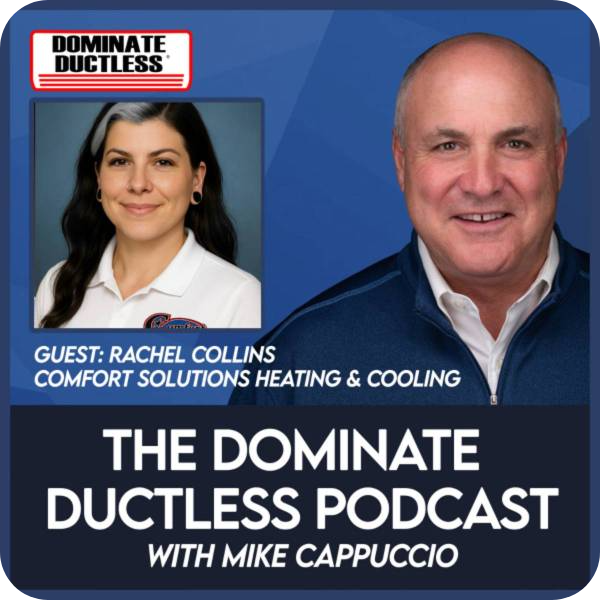
Rachel Collins is a comfort advisor at Comfort Solutions, a family-owned contractor in Winston, Georgia, about 30 miles west of Atlanta.
She spent three and a half years in corporate finance — auditing, reporting, and cataloging every part that moved through an HVAC company’s warehouse before deciding she could sell better than the people she was reporting on.
She was right, and she closed her very first call. In this conversation, Rachel breaks down what a real ductless sales call looks like: a minimum of one hour in the home, a block load or full Manual J at the table, Diamond Builder drawings, and rebate screenshots pulled up live in front of the customer.
She explains why she walked away from a mini-split line that kept coming back with problems, how a single Mitsubishi product training class changed her trajectory, and what it takes to be the only contractor in a competitive bid who can actually show a homeowner the math.
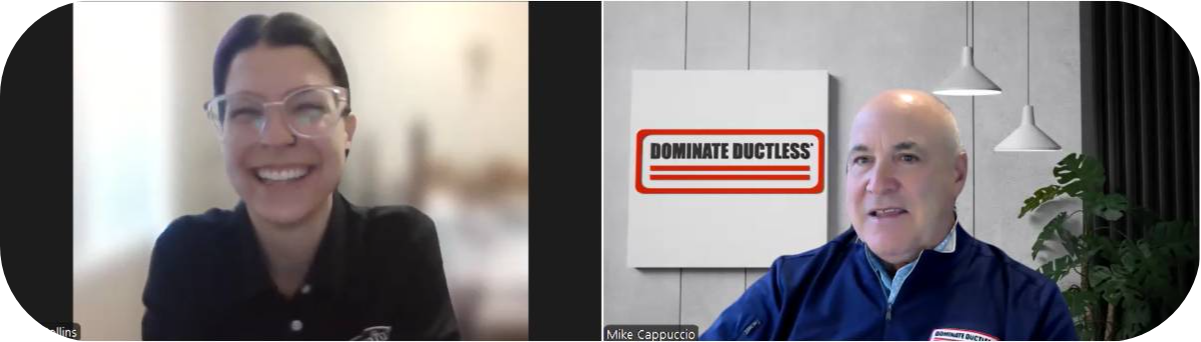
I’ve been trying to get a comfort advisor on this show for a long time, and most of them won’t come. I don’t know if it’s nerves or what it is. Rachel said yes, and about two minutes in you understand why I chased her down after that Mitsubishi Electric event at Disney World — she just popped. I said to myself, this woman is intelligent, and the audience needs to hear her.
What makes this episode different is that Rachel didn’t come up through the trade. She came up through finance. She spent three years categorizing scratch-and-dent inventory and building reports on what a sales department was losing money on, and she walked into her first kitchen table already knowing what every part in the system cost and why it failed. That’s a background nobody’s copying, and it produced a comfort advisor who does something most guys never do: she shows the customer the math.
Listen to how she describes an hour in a home. Block load or a Manual J right there at the table. Diamond Builder on the screen so the homeowner can see where the line set goes. Rebates pulled up live — not promised, pulled up. Scope of work and financing written into the estimate so that when the customer shops it, they can see exactly why she’s better. That is not selling. That’s what I’ve always called system design engineering, and it’s the whole ballgame.
The line I keep coming back to is hers, not mine: a confused customer is always going to say no, and a confident customer will say yes. Write that on the wall of your sales meeting room. Every lost deal you’ve ever had, that sentence explains it.
Minimum time in the home: one hour. Mike floated ten minutes as a joke; her answer was immediate.
Her sequence:
What goes in her estimate: not just prices and model numbers. Full scope of work, the miscellaneous materials that will be used, and her financing options — deliberately included so that when the homeowner shops the quote, they can see the comparison she wants them to see.
Her full line: “A confused customer is always going to say no. A confident customer will say yes.”
Why it matters more than it sounds: every unclear thing in your presentation is a reason to stall. The homeowner won’t tell you which thing confused them — they’ll just say they need to think about it.
What she does about it:
Mike’s supporting evidence: he coaches contractors and reviews their AI-recorded sales calls. In most of them, there’s a moment where the advisor failed to make something visual — and it’s almost always rebates or fuel cost. Comfort isn’t visible either. When customers can see it, they buy.
Rachel’s approach:
Mike’s math on DIY: spend $1,500–$3,000 on equipment online, another $1,000 to get someone to install it, and you’re at roughly $2,500. Replace it in three years and you’re at $5,000. Do it again and you’re at $7,500 — for a system you could have bought once.
The logistics nobody thinks about: a condenser weighs 120–130 pounds, it arrives on a common carrier in a large box, and it gets left where the truck stops. Getting it into the garage is now the homeowner’s problem.
What happened: a homeowner bought a Mitsubishi system online for a three-season room where she left her dogs during the workday. She’d sized it with an online calculator that only asked for square footage — a 20 by 20 room. She called Mike’s company to install it.
On the phone, Mike heard the room had glass on three sides and said what she’d bought probably wouldn’t do what she wanted. He didn’t decline the job — he asked to come look. He ran the load. She needed roughly double the capacity she’d purchased.
How he closed it: rather than leave her stuck with a return, freight, and a common carrier, he asked what she’d paid, credited her for it, and installed the correctly-sized system. The original equipment was brand new and still boxed — he resold it at roughly what he’d have paid a distributor.
The lesson he took from it: “I got back in my truck and I said, boy, did I turn a bad situation into a good situation.”
The policy it created: never decline a DIY install over the phone. Go look first. If the job would be $7,500 installed, back out the equipment cost and charge the labor — say $5,000 — because the margin is still there. As long as it’s equipment they can warranty, take the work. You made the markup and you didn’t even have to pick it up from the distributor.
Mike’s broader point: most contractors get angry about the DIY customer and lose the job on principle. Take the bad and turn it into something good.
Mike’s addition: send your customer service people to product training too. They don’t need to fix anything. They just need to know what the equipment is, roughly how it goes together, and where the limitations are. It changes every phone call they take.
Why this is worth reading twice: a comfort advisor who tells you her flagship line is only 10–15% of her book is a comfort advisor telling you the truth. Take the rest of what she says seriously on that basis.
Rachel attended the Dominate Ductless training that Mitsubishi Electric hosted in Florida, along with Patrick, one of the company’s owners.
What stuck — marketing:
What stuck — the finance side:
Mike’s read on why that’s possible: she’s in a family-owned shop where a comfort advisor can tell an owner to call a time-out and be heard. He relays a conversation with a technician who’d worked at both large and small companies — the money was sometimes better at the big ones, but what he actually valued was being listened to. Small shops let people be boisterous about fixing things.
Rachel’s version: “I’m not a number and the client’s not a number. Everybody’s cared for.”
Mike’s coaching aside on video: he’d just written a video script for a contractor he coaches who admitted he didn’t know what to say on camera or what he was doing when he got to the house. Mike walked him through building it with AI — describe the home, the problem, the solution, and the runtime you want, then fine-tune the output and clean it up in a document. Half an hour later the contractor was shooting the next day, with a shot list and a script he didn’t have before.
The example he points to: David Cochrane in West Virginia, who came out of the same training and flooded his YouTube channel. Mike’s point is that it isn’t really about HVAC — it’s branding. Somebody scrolling at night finds him funny, follows him, and now knows the name of an HVAC company.
Mike’s frame for the customer video: problem, solution, tell the story. That’s the whole structure.
Rachel Collins came into this trade from a finance department, and inside of a few years she’s the person homeowners pick over other Diamond Dealers on the same bid. She didn’t do it with a slicker pitch. She did it by knowing the equipment cold, spending a full hour in the home, running the load at the table, and putting rebate documentation in the customer’s hands instead of promising it later. Every one of those things is available to you right now.
If you can’t leave a ductless quote before you walk out the door, that’s not a market problem or a customer problem. It’s a price book you haven’t built and a training class you haven’t gone to. The question isn’t whether the homeowner will pay for a properly designed system. It’s whether you’ll be the one in the room who can show them why it works.
Listen to the full episode in the player above, or listen on your preferred podcast app.




Mike: Good morning and welcome to the Dominate Ductless podcast. I’m Mike Cappuccio, I’m the owner of Dominate Ductless, and I’m super excited today to have Rachel Collins with me. Rachel works with Comfort Solutions in Winston, Georgia, which for those of you that don’t know, is located about 30 miles west of Atlanta. Welcome to the show, Rachel.
Rachel: Thank you. It’s a pleasure to be here.
Mike: I’m so glad you could come. It’s very rare that I can get a comfort advisor to come on the show. I don’t know what it is they’re afraid of. For the audience — I met Rachel probably about four or five weeks ago down in Disney World at a Dominate Ductless event that Mitsubishi Electric put on. And I’ve got to tell you, she just popped. I said to myself, wow, is this woman intelligent. And I’ve got to get her onto my podcast, because I think she has so much to share with the audience that would be helpful to people about doing things the right way in the comfort world.
So good morning, Rachel, and thank you for joining. Tell the audience a little bit about yourself. How did you get into this racket? How long have you been doing this? Give us a story. Give us some background.
Rachel: Absolutely. How I got into the HVAC industry — I actually started off in finance at a very big company in Georgia. I got into finance, kind of got my hands dirty, helped the company with auditing and reporting. I showed out at that company and got promoted. I worked heavily with the sales department on reporting, to help their sales tactics and their material list of what was consistently lost, and things like that. And after I got into that, I was like, well, I want to be a comfort advisor. So that’s the journey.
Mike: How long were you doing that for before you said, hey, I want to become a comfort advisor?
Rachel: I was in finance and got my hands dirty for probably about three years, three and a half years going on four. I’d mentioned wanting to get into sales. I felt like I had the capability. I touched all the material, the HVAC, so I was very familiar with it. And I felt like I could maybe do better than some of them.
Mike: And you proved it. You definitely can, I’ll tell you that.
Rachel: Education is power.
Mike: Oh, yeah.
Rachel: I shopped around for different companies. I wasn’t a big fan of some of the private equity scope of work and quality, if you will. So I finally landed at a mom and pop shop, which is Comfort Solutions. We’ve been in business since 2011. I really feel like I have the opportunity to show my talents and to help the business grow, which in turn helps me win and helps them win.
Mike: Okay, so let me ask you this question. You get into HVAC sales. What’s the first day look like? Everybody remembers their first day when they became a comfort consultant, or when they were transitioning into it. But your first real sales call — tell us about it.
Rachel: My first real sales call on my own. So it was a tech flip. It was a lovely home in Atlanta. It was a master bedroom system — an air handler, heat pump. I went in there confident, offered three different options, obviously: single stage, two stage, inverter. We sold Lennox equipment in that area. We did not have Mitsubishi available. And I basically educated her — the difference between single stage, two stage and the inverter, what type of warranty she would have. Just went through the process, and she loved me. She was a female. She was like, wow, there’s a female in the industry.
Mike: Oh yeah.
Rachel: And we ran financing immediately. And I actually closed my first job.
Mike: Oh my God, that’s so good to hear. That’s unbelievable. That gives you strong confidence right out of the gate.
Rachel: It really did.
Mike: I can do this.
Rachel: I can do this. I’m good. And it gave me a good impression of how a quality handoff from a tech flip could be.
Mike: So how did you gain that knowledge — what’s an inverter, what’s two stage, what’s this, what’s that? Where did all that come from?
Rachel: I’m a firm believer that education is power. If I’m hungry, I’m going to get it. I’m going to ask about it. I’m not afraid to ask questions. Prior to that, with me working so heavily on reporting for scratch and dent, and equipment coming in, warehouse stock, truck stock — I literally touched everything that goes into HVAC systems. So I knew what parts looked like. I knew the differences in model numbers, from literally collecting data from scratch and dent. I had to categorize everything.
I would also go to manufacturers and they have little printouts — I would take them, I made spreadsheets, I literally studied the stuff. And after I got into the industry selling, I would go up to my bosses and say, I want to go into a Lennox class, a Mitsubishi class, a Rheem class. I want to be educated.
Mike: Wow. So let’s go to the heat pump side of it a little bit. When did you first encounter ductless heat pumps? Because you said in the beginning you didn’t have Mitsubishi to offer at that point. How many years ago was that?
Rachel: That was about six years ago. I was working at a company that sold Lennox mini splits, and every single one we put in that I sold had an issue.
Mike: A product issue?
Rachel: Product issue — possibly an install issue is a possibility. I wasn’t the one installing them. There were definitely issues, and I wasn’t a big fan of it. I have a good rapport with customers where they reach out to me, negative or positive feedback. I want to hear about it. My number is left at the table, and I would get a lot of negative feedback.
We got a new GM at one of the areas I was working at, and I told him about Mitsubishi. I’d heard about Mitsubishi from another friend of mine that was a Diamond Dealer, and we looked into Mitsubishi a bit, and I was like, this sounds like the best equipment ever. We ended up working with Mitsubishi, getting educated with Mitsubishi. And it’s true.
Mike: So you started to find out that it was true, that the product was a good product. So your first initial impressions of ductless heat pumps — it doesn’t sound like it was fun. It sounds like it was a bit of a challenge.
Rachel: Yes, I definitely agree with that.
Mike: So what steered the ship to really make you focus on the Mitsubishi line?
Rachel: Mitsubishi has such a broad horizon of equipment. And they were really the only manufacturer, in my opinion, for a ductless or ducted heat pump, that has such a little fail rate. They’re the ones that really patented the product. They really have their stuff together, and everybody loves them so much they’re trying to come out with their own.
Mike: Yeah, it seems like a lot of people piggyback off of what they do.
Rachel: Correct.
Mike: It’s impressive that they piggyback off of it, you know what I mean? So is there a specific moment — a realization that changed the perspective? Was it just because of the product line you were selling that steered you to this line, or was it something else? Was it a friend? I know we heard a little bit, but there’s obviously something where you really started to believe.
Rachel: I think it was my first class of Mitsubishi training.
Mike: And when do you recall that was?
Rachel: It probably was about three years ago. At that time period I was working at a veteran-owned company. And I was thoroughly impressed with the training, with the products that go with Mitsubishi — the adapters that you can have to keep a thermostat, not having so much electrical for the actual air handler. In Georgia, we definitely get pretty freezing. Unitary heat pumps from Rheem and other products, you require so much more electrical. And if you’re low on refrigerant and you’ve got your little toaster oven and heat strips running — there’s just a lot of things that made me realize how phenomenal Mitsubishi can be.
Mike: So was that an applications class, do you recall?
Rachel: It was definitely a product training. For sure.
Mike: Do you remember who taught it?
Rachel: I could get that for you.
Mike: That’s fine, that’s okay. So initial impressions are — hmm, I like this.
Rachel: Yes.
Mike: And are you saying to yourself, I think I can sell this?
Rachel: I know I could sell it, because I want it in my home.
Mike: Okay.
Rachel: Yeah, it’s the best.
Mike: So now I’m listening in this class that I’m teaching, and I’m seeing who brought you there. And I know Ray brought you there, and I know Ray — Ray owned his own business, very versed, very smart. And he says to me, this girl Rachel has a high focus on heat pumps. What gave you that higher focus at that point? I know you still probably get tech leads and unitary leads, but what makes you want to focus on heat pumps?
Rachel: Nowadays — you know, I love gas, I’m not going to lie. But the reason I like to focus on the heat pumps, especially here in Georgia, I really love the hyper heat systems. The amount of electrical that’s needed for them is significantly less than a traditional air handler heat pump. The warranties are better. The fail rate is less. Literally, the return on your investment is there, and I’m able to show it to the client with Mitsubishi’s website and rebates and the fuel calculator.
Mike: So when you look at your sales mix over the course of a year — let’s go back to 2025 — would you say 10% of what you sold was Mitsubishi products? 20%, 30%, 40%, 50%, 100%? I don’t know, I just like to ask that question.
Rachel: I would say for 2025 it’s probably closer to like 10 to 15%. And that’s because of the product line kind of releasing more stuff. We have a lot of five ton, four ton systems, and I really like to sell the hyper heat systems. I believe it would be increased by next summer for sure.
Mike: So you do see that growing. What challenges are you facing, or were you facing, where you couldn’t get it to 20 or 30%?
Rachel: I would just say it’s really the refrigerant change and the product line changing. There’s been a slight delay in equipment. I talk about things — like the five ton hyper heat system was going to be out end of spring, summer. Well, now it looks like it’s going to be next year. Thankfully I have a couple of clients that have it operating, but I’ve talked about it, they loved it, they want to hear about it and they want it. It’s just not here yet.
Mike: When you look at a ductless heat pump or a ducted heat pump, do you find those harder to sell than other HVAC products, or easier?
Rachel: I kind of feel like it’s a mix. If you educate them and show them the proof in the pudding, they’re going to really believe you. There’s a lot of strong-arm salesmen — used car salesman types out there — that don’t really show the facts and the rebates that you could get to show your return on investment. When I leave a quote with a client, I give them those rebates, I give them screenshots, I give them links. I really show them that I’m not just trying to strong-arm them into a sale, and that this product is phenomenal. Whether it was this much, you’re going to get this much back. So it really goes back to: this is a two stage system from Rheem, but you’ve got a better warranty and you’re going to have better savings on your energy bill.
Mike: You say there’s a lot of used car salesmen out there. There’s people who — I always say remove and replace guys. They read a tag, they go in. I don’t do this anymore, I work more in the training and consulting field, but I hear a lot of guys say, you know, a lot of the bigger companies know how to read a model number, they know how to read a serial number, and they know how to remove and replace. And that’s it.
So what does a typical sales call look like for you? How long do you stay in a home? Can you describe what you do in there — how you get to where you’re getting to?
Rachel: Yeah, absolutely. I kind of touch base with the friendly touch. I see the Florida Gators flag out there and I’m like, man, that game last night was great, you know what I mean? I get the personal touch, crack a joke here and there, because it’s already unfortunate that I’m in your home. I mean, it’s not a good sign.
Mike: Not a good thing that you’re there.
Rachel: So I break the ice, get a little bit of laughter going. I set their expectations when I walk in the door. Hey, you got any hot or cold spots? Was the room above the garage really uncomfortable? Let me know if you had issues prior to the system becoming an issue. And then you tell me what the problem is, and I’m going to go look at everything. I’m going to get the data I need to give you a proper proposal. And then we’re going to sit down at the table and we’re going to talk about it.
During my process of building my estimate at the table, I’m still having casual conversation. I’m able to multitask pretty well. And at the same time I’m educating them about the industry changes, like the refrigerant changes. I do a block load calculation, or even an actual Manual J depending on the situation. I’ll use Diamond Builder if I’m presenting a Mitsubishi product, to show the client that this is going to work in your home, and this is why it’s going to work in your home. I will pull up rebates in front of them. I’ll tell them I’m going to literally add it to the estimate and send it to them.
And I put a very detailed estimate together. I don’t just have prices and model numbers. I go over the scope of work, what’s going to be done, what miscellaneous material is going to be added. And people are shopping quotes nowadays, rightfully so — so I also put my financing information in there. So if they are shopping quotes, they can compare why I’m better.
Mike: How much time do you usually spend in a home? Ten minutes?
Rachel: No, not at all. At least an hour.
Mike: That was a joke.
Rachel: At least an hour for sure.
Mike: At least an hour. So how often is it that you cannot leave a quote in a home? What would deny you from leaving a quote? What roadblock would you hit?
Rachel: Currently, off the top of my head, the only reason I couldn’t leave a quote in a home is if the product isn’t out yet. But then I would still give them a solution that I don’t think is the best solution — I’d still give them Rheem equipment or something like that.
Mike: Can you leave a quote for a Mitsubishi ductless heat pump in a customer’s home today, before you leave?
Rachel: Absolutely.
Mike: You know, 50% of contractors still can’t do that today.
Rachel: It’s probably because of their price book, or they haven’t gotten all their bells and whistles together. That’s one of my jobs here — it helps my company, but it helps me in the field, so I’m okay with doing it. I’m a go-getter.
Mike: With building price books?
Rachel: Correct.
Mike: I’m still amazed at how many contractors can’t do it.
Rachel: I mean, it’s a lot of work depending on the software. There’s always help with certain software, but they might not know how you want to customize it, so you’ve got to figure it out yourself too.
Mike: You know what’s funny? When something takes a lot of work, sometimes people don’t want to do it. And I always say to myself, why is that? Nothing comes easy, as you found out. This is the knowledge-is-power part. If you’re knowledgeable about it, I think it’s easy to do. You know what I mean?
Rachel: Yeah, absolutely agree. And I think that’s what makes me stand out to most clients. For example, I’ve had a client shop multiple Diamond Dealers, and I was the only one that was able to provide the rebate information — the proof in the pudding of what she’s going to get from Georgia Power, and why the hyper heat system was better. Nobody offered her a hyper heat system. And she had a three story home with an electrical panel in the basement, so clearly we had to figure that out.
Mike: There’s the knowledge part of it, right? I believe knowledge is so powerful in a home when you’re selling. People see that you’re knowledgeable about your products and that you’re passionate about it. I don’t even think it’s selling, do you? I always call it system design engineering. You’re not selling anything. You’re designing something.
Rachel: A confused customer is always going to say no. A confident customer will say yes.
Mike: That’s a really good point. That is a really good point. When you’ve truly, thoroughly gone through what they’re going to get, it makes it so much easier. It really does.
So Rachel, you’re in a home now — and I know I’m going to open up a can of worms here — but how do you handle the DIY customer? You walk in and they’ve seen all these things online, they’ve been educated. A lot of people go online to get educated. How do you handle that? There are companies now that sell jobs completely online and don’t even go out to the house.
Rachel: Yes, we have some in Georgia that do that also. How I handle that is — there’s literally a statistic for HVAC that they can Google and verify, that the vast majority of installs are done improperly, which causes energy-robbing components or premature failure. And stuff like Mr Cool — they’re pretty cheap, people put them in. But they’re not nearly as efficient depending on the brand you’re getting, and you’re obviously not getting nearly as good a warranty. You might have a parts warranty, but to ship the part back to you —
Mike: You’ve got to install it yourself.
Rachel: Correct. You’re paying for the shipment. You’re trying to figure out how to install it yourself. And I have a lot of actual examples from clients — videos and photos — that had a Pioneer or a Mr Cool installed for about three years and it’s already an issue. And they bought a Mitsubishi from me because of the warranty and the return on their investment, and potentially also receiving a rebate.
So I have a little fun with it. It’s up to you, it’s your home. But if you’re going to be here for a while, it’s already a pain point that it’s a problem. This is why you should do it, and the best system is Mitsubishi with the least fail rate.
Mike: I mean, do you really save money? Think about it. If you spend $3,000, or even if you spend $1,500 for a piece of equipment online, now you get someone to come out to your house to install it. And like you said, most of them aren’t installed properly. Say you spend another $1,000 to install it, and I’m at $2,500 — let’s just say, for the sake of discussion. And in three years I’ve got to replace that with another system, and now I’ve got to spend another $2,500. And then another three years, I’m going to spend another $2,500, because of the failure rate.
I also say to people — these condensers weigh 120, 130 pounds. They’re going to come in a big box, delivered by a common carrier to your house. And I don’t know how you’re going to move that piece of equipment into your garage. I just don’t know how this is all going to happen.
And I can remember a story where I had a woman who actually bought a system online — it was actually even a Mitsubishi system that she bought online.
Rachel: Wow.
Mike: And it’s a funny story. She bought it for a three season room where she would leave her dogs during the day while she went to work — I think one or two dogs. It was a pretty good sized room, and she asked us to install it. I was talking to her on the phone, and I can remember this as clear as day. She was telling me the system was this big, it was this many BTUs. And I asked how big the room was. And then she told me the room had glass on three sides.
And I was like, wow. I said, that unit doesn’t seem like it’s going to be big enough to do what you want to do. And she said, well, that’s what the online calculator said — it was a 20 by 20 room, that’s what I needed. And I said, look, I’m not trying to do you any injustice, but we don’t want to install something that’s not going to work. I didn’t say I didn’t want to install it. I said I don’t want to install something that’s not going to work. I said, maybe you might want to have us just come out and take a look at it.
Well, when I looked at it and ran the load on it, it needed double the size of the unit that she had. And she’s like, well, what do I do now? And I’m like, well, you could probably send it back and try and get some money back. I don’t know if that’s going to work — you’ve got to call the common carrier to get the thing back and do all this.
But knowing what the product was, and I saw it in the garage, it was all boxed up, brand new piece of equipment — I said, look, what did you pay for that? And she told me what she paid. And I said, we will credit you for that and we’re going to install this. And she said okay. So it was a whole change-around of what happened in the home. And we got the job. And I got the equipment, and it was the same price as what I would buy the equipment for from the distributor, or a little bit more, so I could go resell the piece of equipment. It was fine. It was all brand new, it was all boxed. It just wasn’t the right application.
And I got back in my truck when I left and I said, boy, did I turn a bad situation into a good situation.
Rachel: You sure did. You turned that frown upside down.
Mike: It’s a funny story of how it happened. And I said to myself, wow, I’m never going to say I don’t want to install a DIY unit on the phone again. Before we do it, let’s just go out there and make sure it’s going to work.
And then we came up with a motto: if our job is $7,500 to do it, take the equipment cost out — whatever it is — and just charge them the $5,000 to install it, or whatever it is. We’re still making our margin. Go do it. As long as it’s a piece of equipment we can warranty, that’s fine. They just bought it from somewhere else. I made the markup on it, and I didn’t even have to go to the distributor and pick it up.
Rachel: Exactly. A lot of guys get so negative about it and fall apart. They get so mad with it.
Mike: I’m like, don’t take the bad — take the bad and turn it into something good.
Rachel: Exactly. You’re able to educate them and get them hopeful for a true solution.
Mike: What gives you confidence when you present the system? What gives you confidence about it?
Rachel: Obviously, I love that I’m a Diamond Dealer. I can prove the fail rate. There are a lot of tools with Mitsubishi that I absolutely adore — Mitsubishi Comfort rebates, the Diamond Builder. I can show them. And I draw. I make a joke where I say, I’m going to take the kids’ picture off the fridge, we’re going to put a —
Mike: A system designer that knows how to draw.
Rachel: Correct. So I really put a visual in there, because line sets, 14/4 low voltage wire — it’s a lot of not understanding.
Mike: Well, that’s like what you said. People are visual. When they see the knowledge and the visualization, it works really well. I’ve listened to some of the AI recordings from guys I coach, of what they’ve done in homes. In most, if not all, they always designate something they weren’t visual about, something the customer didn’t understand. And a lot of it is rebate and fuel cost — things that people visually can’t see. They can’t see the rebate. They can’t see the tax credit. Never mind that they can’t see the comfort, because that’s not a see-able thing. When they can visually see things, they see it a lot better. They really do.
Rachel: Yeah, I’m the type of person, I want the proof in the pudding too. So why wouldn’t they?
Mike: So do you use it in your own home?
Rachel: I will use it in my own home. I currently don’t have it, but I will be.
Mike: Confident in the company?
Rachel: Yeah, I’m 100% sure. And I’m going to have the hyper heat systems.
Mike: What training and education do you find most valuable to yourself?
Rachel: Honestly, I really like product information, product training. I actually like to go into install training, service manual training. I like to know how things work, even though I’m not always the one to go out in the field and install things. It gives me a better understanding, especially when I’m sitting at the table with an engineer who’s very interested in Mitsubishi. I like to really show out and show them that I know what I’m talking about.
Mike: I’m just as smart as you are. Maybe not — but I’m pretty darn smart about the HVAC industry.
Have you been to technical training on the Mitsubishi side, in one of the factory training centers?
Rachel: I have not been in the factory training centers, but I have been in Apex — a small showroom where we’ve worked on equipment and diagnosed equipment issues a few times.
Mike: Was it a Mitsubishi training center, like a factory authorized one that the distributor had?
Rachel: I believe so, yes.
Mike: Was it a one day class or a two day class?
Rachel: It was technically a two day class.
Mike: It was a two day class. Yeah. You know, I even advise customer service people to go to something like that, because they get to see what they’re talking about to people on the phone. You don’t have to fix it. You don’t have to know how to fix it. You just have to know what the limitations are and how it comes together. I find that very, very helpful with people.
Rachel: I agree.
Mike: If you were to look at that training we did in Florida a few weeks ago, what are the top two or three things that you walked out of that room with that day?
Rachel: Definitely the marketing strategy. That’s something that has definitely changed in 2025. The past ten years, we’ve kind of moved away from commercials, TV, billboards. We’re more on social media. We’re sucked into our phones — silly brain rot videos. So that really helped my perspective of an easier, more affordable marketing strategy, and just getting our name all over the place. The marketing really stood out to me.
And since I’m a finance girl originally — you guys went over quite a few pieces about labor board and costs. And I might have my nose into things that I shouldn’t, but I felt like things were happening here that needed to be looked into. And with Patrick, the co-owner, being there also, we were able to talk about that after the fact. And I was like, I think there’s a problem here. And I think we need to look at this here, because I think this is happening here. And he did it.
Mike: So Patrick was sitting there with you as the co-owner — I recall him sitting there next to you, and he was really looking at some things. So you, as a comfort advisor, start telling him — the co-owner — time out.
Rachel: Well, I mean, he definitely —
Mike: He’s getting it, but you’re the one who’s making him really aware of it, it sounded like.
Rachel: Right. And I’m the numbers girl. I’m the only comfort advisor. Some people will get comfortable in the company and confide in me. And I’m about the company doing very well. I’m going to be a very transparent person when it comes to that.
Mike: How does he take it when you start telling him, hey, we need to make a few changes here?
Rachel: I think we have a very open relationship, because I want us all to win. I don’t expect to get any ownership, but I just want to make sure that no hands are dirty and things are being done ethically.
Mike: Yeah. And you know what, I think you see that a lot, and I feel that’s a really nice comfort factor in small, family owned mom and pop businesses. I was talking to a tech about this the other day, and he was saying, you know, what kind of environment do you like to work in? He said, I’ve worked in big and I’ve worked in small. And in the big, he said, yeah, the money might be a little bit better sometimes. But he said, you know what I really enjoy? It’s not about the money. It’s when people respect me and listen to me — when they see something that is not being done right, or something that could help the company. And I find that in those smaller environments, they tend to want to help more. They want to be more boisterous and help more. And I find that’s really a good thing when you’re in those types of businesses.
Rachel: I couldn’t agree more. I’m not a number, and the client’s not a number. Everybody’s cared for.
Mike: That was my company. When I had my company, we would do anything we needed to do to make the customer happy. My install manager would come to me with something, and I just said, look, do whatever you’ve got to do to make that customer happy. I don’t care what it costs. I don’t care what we need to do. I don’t care if we need to take it out and put in a new one. Just make the customer happy. We’ll deal with the money side of it later.
And that drives a business. That completely drives everything. And people understand that. They really get that.
Rachel: And Jason and Patrick — Jason is the owner — they are very, very involved with clients and having a personal touch. And after that training we went to in Florida that Patrick joined, it really put a lot more motivation into both of us. It really sparked our drive. We came closer, to be honest. We were like, let’s get it. Let’s make some videos. Let’s make some changes and let’s run.
Mike: Oh yeah.
Rachel: It was very exciting. It was a pleasure to be there. It was eye opening. It was great to meet all those other contractors.
Mike: David Cochrane, he’s a hoot, from West Virginia. He went back — I’ve never seen more video on his YouTube channel than in the past two months. He’s just out of control with the video.
Rachel: They’re great.
Mike: You watch some of the stuff?
Rachel: Yeah, I follow him.
Mike: He’s an out of the box, crazy thinker. And it’s not even about HVAC — it’s just branding and getting his name out there. It’s who he is and what he’s doing and how he’s doing it.
Rachel: Even if you’re not looking for HVAC, you might just be scrolling at night and be like, man, this is hilarious, I’m going to follow him. And then you know the HVAC company. So it’s a good strategy.
Mike: He talks about certain people and different guys that do different things — he wants to be that guy. So I guess, what changes have you implemented that are going to have the biggest impact for this year coming up, do you think? They could be very subtle changes, little tweaks. What do you think they are?
Rachel: We’ve got a little bit more eyes on the finance end, and our guys, if you will. And also the marketing — we’re going to do quite a bit of videos. We’re going to do an interview with a few clients that have converted from gas systems that were ancient and converted to a hyper heat system. After the holidays we’re going to have an interview. Her energy bills at the peak of summer were over $400, and at the peak of this summer they were like $167.
Mike: Problem, solution — tell the story.
Rachel: Yes. And she was very adamant about not having fossil fuels in her home.
Mike: So have a good strategy with the video. Once you’ve created it — what are we going to do with that video? What’s the strategy going to look like? How is it all going to come together?
I actually just wrote a script for a company that I coach the other night. I was talking to him and he said to me, Mike, you know what the biggest thing is? I said, what challenges do you have when you go to shoot a video? He looked at me and said, you know what — I don’t know what to say sometimes, and I don’t even really know what I’m doing when I go out there sometimes.
And I said, time out. Let’s just stop. We’ve got to do some thinking here. And again, artificial intelligence plays a huge factor in that. You go on and you tell Claude, I want to do this, and this is the type of home I have, and this was the problem and this was the solution, and I want to shoot a three to four minute video on this — and what do I need? And it just went through it. You go in and you do a little fine tuning with it, put it into a Word doc and clean it up.
After half an hour I said to him, what do you think? He goes, give me that thing. He goes, I’m going out to shoot the video tomorrow. And it had everything — what shots you needed, what you needed to say. A guide. He didn’t have a guide to what he really wanted to do with video. And I was looking at the videos he was doing and I’m like, these really aren’t good. So just some advice, you know what I mean?
Rachel: Yeah.
Mike: I’m very, very glad to hear that. That’s what’s going to happen in 2026. It’s been great chatting with you. Thank you for your time. I wish you happy holidays. I really want to talk again in a year.
Rachel: Yes, I’m excited to talk again.
Mike: I want to see where this all goes. I want to hear some good video stories. I’m going to keep my eyes on video and we will go from there.
Rachel: Yeah, absolutely. Looking forward to talking to you again, and looking forward to the growth.
Mike: So Rachel, thank you for joining the show. Thank you for coming on. Thank you for sharing your journey. It was a pleasure to talk to you today.
Rachel: Absolutely.
Mike: I’m sure we’ll talk to each other more. Our paths are going to cross, I promise you. Take care, and thanks for coming on.
Rachel: Take care. Happy holidays.
Mike: Happy holidays to you too. Bye bye.
