If you would like to be a guest on my podcast to share your take on the opportunity that ductless heat pumps offer today’s HVAC contractor, please drop me a note at info at dominateductless dot com or click here to send me a note through my contact page.
Tripp Jordan from Sales Builder Pro shares his journey from insurance agent to top-performing HVAC comfort advisor (65% close rate over 4,500 calls) to sales trainer. The conversation exposes a shocking reality: 50% of HVAC contractors still cannot leave a quote for a heat pump system at the kitchen table. Tripp explains how Sales Builder Pro solves this with built-in ductless design calculations, real-time proposal tracking, automated follow-up systems, and the ability to quote complex multi-zone systems in under three minutes. The platform has helped contractors generate an additional $330,000 per sales rep by enabling first-call closes with higher margins.
This episode tackles the elephant in the room that nobody wants to admit: Half of all HVAC contractors are still using pen and paper or basic spreadsheets to quote jobs—and they wonder why they’re losing to online companies and aggressive competitors. Tripp’s insider perspective is invaluable because he’s lived it—4,500 actual sales calls, nights and weekends in attics and crawlspaces, facing rejection, closing deals. When he says “if I leave the house, my close rate goes down,” he’s speaking from battle scars, not theory. What really hits home is the “Hot and Cold Report” feature that tracks who’s opening your proposals in real-time. Imagine knowing a customer is looking at your quote right now and calling them at that exact moment. That’s not just clever—that’s game-changing. The most powerful moment: Mike admitting he couldn’t have sold his business at the numbers he did without the right quoting tools. That’s the truth nobody talks about: Your business value isn’t just revenue—it’s systems that work without you.
Key factors that separate 40% closers from 65% closers:
Bonus tip: When customer says “I’m waiting on two other quotes” and they’re late, ask: “If they’re slow getting you the quote, how do you think they’ll be on service?”
Core Function: Sales quoting tool designed to help contractors close more deals in less time with higher margins while creating great customer experience
Key Features:
What It Does:
Why It Matters: Mike’s question to contractors: “How many times have you sold a deal 6 months to a year after you gave the quote?” (All hands go up) “How did that happen?” “They called me.” That’s found business—imagine if you actively pursued those deals.
How It Works:
Script Example: “Hey Mike, I was just thinking about you!” Customer: “This is crazy, I was just looking at your proposal!” “That’s interesting! What can I clarify for you? Are you ready to move forward?”
Professional vs. Hobbyist: Professionals follow up consistently. But even professionals struggle with knowing WHO and WHEN. This solves it.
How Contractors Achieved This:
Math: $300K increase × 7% commission = $21,000 extra per sales rep just from not walking away from deals
Common Objections:
Tripp’s Responses:
Why Visuals Matter: Mike’s AI note-taking experiment revealed he needed:
Sales Builder Pro solves this:
Tripp’s closing technique: “Mr. Jones, remember I said we don’t do anything halfway? Look at the degree of detail in our site survey. We don’t take anything for granted—we’re going to do a great job for you.”
Timeline: 30 days from invoice paid to successfully quoting in homes
What’s Required:
Reality: Some contractors want Sales Builder Pro to build their price book for them—Tripp refuses: “You know your business, your pricing, your market. We’ll help, but this is YOUR business.”
The Amputation Analogy: “If you cut your finger and had to sit in ER for 8 hours, you wouldn’t be working. So cut your finger off today and work on your price book instead.”
Integrates With:
Key Point: Service Titan is amazing for service and dispatch—but NOT designed for complex heat pump sales. Sales Builder Pro handles the sales, then pushes data to Service Titan.
Sweet Spot Customers:
Market Reality:
Sales Builder Pro Advantage:
Mike’s Perspective: 25 years ago people said “you just hang plastic boxes on walls.” Now everyone’s in the heat pump business. Why? It’s extremely profitable. But you need professional tools to capture it.
Tripp’s Most Gratifying Result: “More than helping them make more money—which is great—I’m giving dads back to their kids, husbands back to their wives. That’s more important to me.”
Contractor Testimonial: “I don’t go home and do quotes anymore at night. You saved me two hours a night, Mike.”
The Trade-Off:
Mike’s Confession: “I would have never been able to sell my business at the numbers I sold it with if we didn’t have the tools to close the deals.”
Business Scalability:
Business Sale Reality: Businesses with systems that work without the owner are worth more. Pen and paper quotes that require the owner’s knowledge have zero scalability and minimal sale value.
If you’re still using pen and paper, basic spreadsheets, or leaving homes to “email quotes later,” you’re not competing in 2026. You’re a hobbyist getting paid like a hobbyist. The professionals are using tools like Sales Builder Pro to close more deals in less time at higher margins—and they’re going home to their families at night while you’re building quotes. The heat pump market is exploding, and contractors with the right tools are capturing the profit while everyone else watches from the sidelines.
The question isn’t whether you need a professional quoting tool. The question is: How much longer can you afford to compete without one?
Listen & Subscribe:
Listen to the full episode in the player above, or listen on your preferred podcast app.




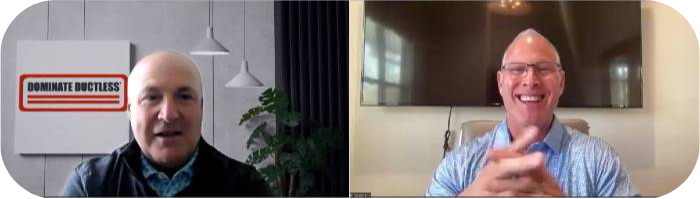
Mike: Good morning everybody, and welcome to the Dominate Ductless podcast. I’m Mike Cappuccio. As you all know, this morning I have with me a special guest from an associate partner that we’ve just signed up with and working with—Tripp Jordan from Sales Builder Pro. Good morning and welcome, Tripp.
Tripp: Mike, thanks for having me. It’s good to catch up with you. Appreciate it.
Mike: Yeah, I always enjoy seeing you and talking to you and going over a few things. And, um, you know, I’m really, really super excited about this partnership that we’ve developed with Sales Builder Pro. I mean, as a contractor, I used it. I was probably one of the prototypes—go back 15 years ago when I first met John at a conference and he said, hey, I got this product. And, you know, I was like, super excited about it. And, you know, I love talking about products that I actually used for a long time too. So I guess for the opening part of this is just, you know, for contractors who haven’t heard about Sales Builder Pro, give us the 60-second pitch on this. You know, what problems does it solve and who’s it built for?
Tripp: Okay. Yeah, sure, Mike. Really, Sales Builder Pro is a sales quoting tool that’s designed to help the contractor close more deals in less time with a higher margin, which is important. Right? You talk about margins. Also, I think it’s got a key component people forget—it’s a great experience for the homeowner, and the homeowner’s who’s paying everybody’s bills, right?
Mike: Exactly. Yeah.
Tripp: You know, I guess when you say who is it for and what problems does it solve, it’s really for any contractor that wants to make more money faster, solve more problems at the kitchen table. And I know we’re going to talk about that. Maybe they’re watching this podcast and they think I’m already doing pretty good. And I don’t doubt that they are. But we can help take them from good to great, I believe, with this tool. Yeah.
Mike: I mean, I can’t tell you how many contractors that I’ve worked with across the country inside of my trainings. And I still today see 50% of HVAC contractors cannot leave a quote for a heat pump—I’m not talking about unitary, I’m talking about a heat pump system or a ductless system—at the kitchen table. 50% of them still can’t do it today because they don’t have a tool to do it. So I guess, you know, quick background here: How did you personally get into the HVAC tech space and what drew you to Sales Builder Pro? I always like to find that answer out.
Tripp: Yeah, interesting question. I’ll keep the long story short for the podcast, right? So, uh, years ago in 2014, which is when I got into the HVAC business, prior to that I owned an insurance agency as an independent agent. I did a lot of Medicare and final expense and annuities, rollover money, stuff like that. And that was okay, but I got burnt out and it was extremely expensive. I was buying leads and chasing, driving to different states and all that kind of stuff. And I told my wife, I said, I’m ready for a change. And I jumped on—I think it was Monster.com back then in 2014.
Mike: Yeah. Wow. Yeah, I remember Monster.
Tripp: Yeah, amazing how fast things change. So anyway, it was maybe three pages back—I saw an ad for a comfort advisor for a big company in Charlotte, which I recognized.
Mike: Okay. Wow.
Tripp: And, uh, I tell you, when it said “looking for a professional salesperson, earnings up to $250,000 a year,” I was blown away. Because I had judged the industry, Mike. I would see guys in trucks and vans with HVAC logos and I thought, well, they’re probably making 50 grand. I judged them. I didn’t know that you could make that kind of money, and I immediately polished up my resume, drove that thing down physically the next morning, handed it in to the sales manager, and fortunately he offered me the job. And I always like to say I admitted to him, I can’t even spell HVAC. I’m that new. I don’t know anything. But he knew I was sincere and I told him I was a hard worker and a quick learner, and I’d never do anything to paint the company in a bad light. And I had a great run there for about three years, and then sold for another company for four years. About seven years overall as a comfort advisor.
Mike: Okay, so you were in the—so I never knew this, that you were actually in the HVAC space.
Tripp: Yeah. Yeah.
Mike: Wow.
Tripp: Exactly, Mike. So I think that’s why I’ve been, you know, fortunately really successful with John at Sales Builder Pro because I know what these guys are going through in the houses because I did 4,500 calls. So I know what they’re doing. I know what they’re struggling with. I know what they’re thinking when they walk out without a sale. And that’s not good, right? So what happened was I had kind of gotten burnt out on nights and weekends, attics, crawlspaces, all that fun stuff, and had a grandchild on the way. Okay. And I started looking for something different. I didn’t know it was going to be remote. And then a friend of mine, really out of nowhere, said, you need to meet John, the owner of Sales Builder Pro. And I said, I don’t even know what that is. And, um, John did a demo for me. I was fortunate enough to get the interview, went through that process. When I saw the app, when he did the demonstration, I said immediately, if I would have had that all seven years that I sold, I would have made more money faster, and it would have been a lot better experience for all my customers. So I was sold. I said, I’m in if you’ll have me, take me, kind of thing.
Mike: I remember the first time he showed it to me too, and, you know, he showed it to me at a dealer event or something that we were at. Might have been a national event or something. And I’m going to roll the clock back—it’s got to be 15 years now.
Tripp: Yeah. Yeah, I believe so.
Mike: And I was like, wow. I said, this is a good tool. Yeah. I said I was just blown away, Mike. I guess I thought if I’m blown away by this, these dealers and contractors all over the country, they gotta be in the same boat that I was.
Tripp: Absolutely. Yeah.
Mike: You know. So yeah, I know we’ll get into a lot more detail about how to help these guys.
Tripp: Well, that’s an interesting story. But I mean, I guess, you know, in your experience, you’ve probably worked with hundreds of HVAC contractors today that you’ve done demos for and done sales with. What’s the number one sales mistake you see comfort consultants making in the field today?
Mike: Well, amazingly still to me, Mike, when I do demos every day—and you know, I’m busy from sunup to sundown doing demos across the country—but it’s sad, but it’s still surprising to me: the number one problem, over half don’t ask for the business at the kitchen table. And me and you’ve talked about that at events. You know, I was groomed here.
Tripp: I think it’s fear of rejection at that point.
Mike: I think it’s that and/or they don’t have the self-belief, and we try to help them with all that stuff with Sales Builder Pro. So yeah, it’s staggering to me that you would go through the effort of generating that lead, which is very expensive, to get in the door and then go through all your walk-through, build rapport with the homeowner, and then go, “Hey, I’ll send you a quote in an hour or two or two days or something.” I’m like, they have an HVAC problem. You’re in the HVAC business. We gotta figure this out. I’m here today and I can provide a solution. Let’s make this thing work, Mr. Jones, or whatever the customer’s name.
Tripp: I think still it’s staggering. I think I’m going to chime in on it, but I think what I see—the number one sales mistake that a lot of guys make too, along with not having a quoting tool—I see it’s extremely crazy. I just can’t understand why they don’t have a tool to give a quote. They’ve asked you to come to the house number one to do this. And there’s so many online companies now that are going to destroy them because with AI and how fast things are moving today. But the other part of this is that they basically just don’t have a good process when they get into the house. Like they don’t even know why they’re there. Sometimes I try to really hone in on what I do in my training to get them to the Sales Builder Pro tool is to say, “Hey guys, you got to first find out why you’re there, what kind of system do you have, what kind of fuel do you have, what kind of cost savings do you have if you’re going to switch to a heat pump or whatever system you’re working with. You know, what rebates and incentives and financing do you offer? What do you like? What do you dislike? How is this going to get installed, and how is it going to perform for me?” And, you know, at the end of it, what’s it going to cost me? If you’ve gotten the first 6 to 7 parts of this done, the last part’s the most important part: what is it going to cost me? And you can’t give that to him.
Mike: And it costs are rising.
Tripp: You know what I mean?
Mike: We live in a microwave society. We want answers now. So if I don’t have—I’m down in Charlotte, North Carolina, of course—and if I don’t have air in the summer, I don’t want to wait three days for a quote. Can you put it in tomorrow if we can figure this out? I need it tomorrow. We’re hot.
Tripp: Sometimes I even need it today.
Mike: That’s right.
Tripp: I can see some of these—and how fast HVAC is moving today, it is more of a two-day thing. Why do so many HVAC contractors still rely on handwritten quotes, basic spreadsheets? And, you know, I don’t think they even really know what this is actually costing them. Why are most guys still relying on that? I don’t understand.
Mike: Yeah, I agree with you 100%, Mike. I think just human beings in nature, we’re slow and hesitant for change, right? And so if, like when I talk to guys that still do handwritten quotes or templates or something like that, they go, “You know, it’s just the way I’ve always done it.” And I go, “Well, that doesn’t mean it’s right now. That’s okay ten years ago. But there’s better ways now. You’ve got to adapt to better ways or you’re going to be left behind.” If you’re still doing pen and paper or templates, rather inferior platforms, right. And as far as your question, what’s it costing them? It’s hard to even quantify. But it’s a ton, right? Especially if they’re not quoting at the table. If I know for a fact—and you do too—if they leave the house, their close rate goes down, not up.
Tripp: Oh, absolutely.
Mike: You’re the magic in front of the customer. When you leave, the magic leaves. So you need to get that quote even if you don’t get the deal right then—you’ve made the impression, you’ve got it off your plate. And another key thing to Sales Builder Pro: once you’ve quoted the job, you don’t have to keep going back picking that quote up, so to speak. Go enjoy your family tonight. Don’t put together quotes.
Tripp: And the other part of it, Tripp, is this: You just made a magic point, which is, okay, your close rate goes down when you leave the house, right? And what happens when the second contractor or a third contractor is coming in an hour later? Maybe people’s time is valuable. All you’ve done, you’ve closed the door on yourself and opened the door for them if they have the tools to provide what the customer is looking for today.
Mike: Agree. I know this, Mike. If a contractor didn’t close it and I’m the next guy up in an hour or two, or if it were you, we’re closing that deal. If it’s possible, we’re getting that deal. “Hey, Mr. Jones, are you tired of seeing—you’ve seen four guys just like me. What if I actually provided a solution and we could install it first thing in the morning? Is that good?” Yeah, it’s good.
Tripp: And when people think about this, people just don’t call people out to their house to get an HVAC quote. They’ve done research. They’re further down in the funnel, in the sales funnel. They’re ready to make a decision. Now we just got to find out: Can we solve the problem? Do they like us? Is there trust? And can we provide a price? And I see so many guys get there—like they trust but they can’t provide the price.
Mike: I agree. I agree.
Tripp: I still can’t believe that, you know?
Mike: Great. I’m—again, I’m probably—I don’t know how many hundreds or maybe thousands of demos I’ve done for John in four years. And when they say, “No, I don’t do a price. I just send them a quote via email,” I can’t believe it. I still cannot—
Tripp: Oh God.
Mike: There’s a big difference.
Tripp: It’s not—I’m telling you, I keep going back to when I ask guys for a raise of hands. I say, you know, honestly, I have 20 contractors in the training. And I say, “Honestly, guys, I need an honest answer. Who can leave a price today for a five-zone ductless heating and cooling system in a home?” And they’ll be like… maybe sometimes even none can raise their hand. They say, “Oh, I gotta go back, I gotta design that, I gotta put this together.” And I’m looking at this going, this is a tool that does a design for you guys. And it’s all quiet. It’s all quantified and qualified that it is the right size. It does have the—it’s showing you the rates. It’s showing all of this. You know, I guess there’s a big difference between contractors who close 40% and the ones who close 65%. In your observation, what separates these two people apart?
Mike: Yeah. Boy, that’s big, right, Mike? It’s funny you said you used that number 65%. And again, I’m not being boastful or anything, but I think over my career, I think my close rate was around 65%. And then—that’s right, right? Because I hear guys at 20 and 30. I’m like, oh man, you need to jump on this immediately. But I think there’s several factors. Number one, you gotta believe that you can close 65% up here. If you don’t think you can, you’re not, right? So you need to elevate your thinking and your mindset. Work on yourself. The second thing is, we’re talking here about Sales Builder Pro. Do you have a legitimate quality tool that can quote in front of the homeowner that day, the first call? How do you use financing or do you even use financing as a closing tool? That’s certainly a big thing there, right? And then probably the biggest thing: ask for the business while you’re there, like we said earlier. So I think all those factors come into play for somebody to go from 40 to 65%. And maybe one that goes overlooked—and I was talking to a comfort advisor the other day, he was asking advice—and I said, I said, “Just because, let’s say Mike’s the customer and he says, ‘Hey, Tripp, this has been great, man. I may just need to think about it.’ Don’t leave when he says that. He didn’t kick you out. Keep the conversation going, right? Stay in the fight a little longer.”
Tripp: Something he needs to think about. Maybe I want to help him think about what he needs to think about, because there’s obviously something there that he needs to think about that is stalling. And what is it? In most times, I find it’s that you haven’t basically clarified something 100% that’s leaving a block in the brain at that point and saying, you know—and that could just be something that—I did a mock sales call a few weeks ago with my wife.
Mike: Okay.
Tripp: I did it for my training. I did it for the training, but there was a reason why I did it. And I did it because I was running an AI Plaud recorder while I was doing—or a Plaud note taker while I was doing the sales call with her, and it was a mock sales call. Well, I took the AI data after the sales call, and the tool basically told me what I needed to get better at. And I said to myself, okay, I needed to clarify. I needed a better tool to clarify rebates and financing to the consumer. I also needed a better visual concept to show the homeowner of what I was talking about. And I thought to myself, I don’t have Sales Builder Pro in front of me. I’m just talking to her in the sales call. And I’m saying Sales Builder Pro would have done all of this for any comfort consultant in the home that is doing this, because you have spots that we’ll talk about—the product for the visuals. Some manufacturers have the visuals already built into the tool, and the rebates and financing can get built into the tool as well. So—and I think contractors don’t fully understand that that can be a roadblock. But these AI tools are now telling me what the roadblocks are, and we have tools to solve it. So it leaves me right into the next question: Walk us through what the customer experience looks like when a comfort consultant uses Sales Builder Pro on a call from the moment they walk in the door into actually getting a signature. You know, tell us, tell the audience a little bit about what this experience looks like.
Mike: Sure. Yeah, I’d be glad to. First, I was going to say it sounds like your Plaud tool was hanging out with Sales Builder Pro, because that’s exactly what—
Tripp: Yeah, it’s like this little Plaud device. It’s a little recorder. I don’t know if you’ve seen them, but it’s really a note taker. And I bring this up in trainings and I tell guys, look, for you to take notes—look, I find you learn more when you listen versus talking. And this little device is listening the whole time, and it’s taking notes.
Mike: Yeah. Fascinating. And it’s also what we have access to nowadays.
Tripp: Exactly. So in the end, I was scared of it. But we have a tool.
Mike: Basically tells you what you need to do better. Well, now I need to find a tool that has it. And this tool already had it. And I’m saying to myself, wow, for seconds I’m looking at a dialogue that’s saying what I need to do. So you could just excuse yourself and go to the men’s room and go look at your phone and look at what he’s possibly thinking about that he doesn’t understand because it’s already telling me what I didn’t clarify for him that I could do better.
Tripp: Yeah. Amazing. Yeah, but—
Mike: You have to have a tool to do that with. You have to have—you got to have it somewhere.
Tripp: I think what you’re saying, like almost really to sum it up: if the guys listening and gals listening to this call, in this podcast, if you treat HVAC sales as a profession, it’ll pay you like a professional. But if you treat it like a hobby, meaning you don’t try to grow and improve, it’ll pay you like a hobby. But if you want to make a ton of money, you can do it in HVAC. I did it, you did it, you know? But anyway, I know you would ask me—
Mike: I would have never been able to sell my business at the numbers I sold it with if we didn’t have the tools to close the deals that we had. And I’ll leave it at that.
Tripp: That’s a mic drop. If I had one, I’d drop it, but—
Mike: And I could bring on any salesperson, honestly, and have them working Sales Builder Pro within an hour.
Tripp: Yeah. Agree.
Mike: Within an hour.
Tripp: It is not hard to learn.
Mike: It’s the scalability is so—
Tripp: A little bit of coaching with a consultant. But within one day you’ll be quoting with that tool. Am I correct by saying that?
Mike: I agree. Yeah. And essentially, Mike, all the knowledge you’ve got in that awesome brain of yours, you’re putting it into an app so somebody else can duplicate it on the sales team. That’s all we’re doing. We take all that amazing knowledge and set-and-forget-it pricing, right? So you set the pricing. It’s always going to be accurate. But as far as the homeowner, what you would ask previously, if I come in with Sales Builder Pro as a tool and they’ve had a couple of guys out there with pen and paper, maybe a template or something like that, and I’ve got this awesome, slick design tool right on the iPad, I can show videos from the OEMs—
Tripp: Many videos are there. Videos. Or you can add your own if you want.
Mike: That’s right, that’s right. You can customize those as well. Add whatever you want. The fact that I can talk to them about financing it and give them in one clean place multiple financing options so they can go, “Yeah, I can’t afford that one, but that one I can afford,” instead of when I used to sell in the homes, I would have to have different payment factors. “What’s that again?” I pull out the brochure for Wells or Synchrony or—I’m like, we build them right into the quote.
Tripp: The three numbers are right there. You tell them which one you’re going to use.
Mike: And then one key thing which I know you’re a big fan of is our site surveys. And that’s important for the install team to know exactly what are we looking at when we get this install. So we’re not flying in there blind. That’s important. But also I would use that as a closing tool. I would show Mike—”Mike, remember I said Tripp’s Heating and Air, we don’t do anything halfway. Our install is amazing. Look at the degree of detail we go through.” When I’d show them that site survey within Sales Builder Pro and go, “We don’t take anything for granted, man. We dot every I, cross every T. We’re going to do a great job for you.” As soon as—
Tripp: I actually—I don’t know if I was or not. I’m not going to take any credit for that. But I was actually with John saying, “John, look, I have a site survey. We need to—I need to get this thing built. I need to put it into Sales Builder Pro so I don’t have to have two forms. I want it in one form and I want it in one place.” And he’s like, “Okay, let’s go to work.” And we actually developed it together.
Mike: You do get credit, Mike. He told me that. Yeah.
Tripp: That’s right. I was like, okay, let’s just put this together and make it work. Because again, I have another app and my explanation to him—I don’t mean to pat myself on the back or smell like—”John, I have a camera. I’m taking pictures. I have to then take the pictures, I have to put—I want everything in one spot.” That’s right. I think that’s what makes the app easier to work with, you know?
Mike: Not only just the pictures, as you know—I mean, I’m preaching to the choir, right? But yeah, they put the pictures in that form. As you know, they can draw: “Here’s where the line set’s going to need to go.” That’s critical data for the install team when they get that job. So I mean—
Tripp: Somebody needs that.
Mike: Everything.
Tripp: Someone needs that to show how this job’s going to get put together. Am I right or wrong?
Mike: They better have something or they’re going to make—they’re going to get a bad review because they’re going to blow the job. And that’s not good.
Tripp: Exactly.
Mike: I mean, so, you know—
Tripp: You’re the only proposal tool—I find this amazing—on the market today that includes ductless design calculations built in. For a contractor who’s been doing ductless jobs because they couldn’t quote them on the spot, what does that change for them? Think about that.
Mike: Yeah.
Tripp: Mike, literally at least a couple times—everyone’s got a unitary pricing tool. Am I right or wrong?
Mike: That’s right. Yeah. It’s the multi-zone stuff that they—a lot of times they’ll literally just—I’ve had guys go, “Tripp, I walk away from them because they’re too complex and I’m embarrassed I don’t know how to quote them.” I’ll go, “You’ll walk away from a $15,000, $20,000 multi, $30,000 multi-zone job because—” “You know, well, you better sign up today because we can help you with that, right?” So within our proposal tool, Sales Builder Pro, we’ve got built-in guardrails. So they can never mismatch components. They can’t pick the wrong line set. They’re never going to pick something that’s over capacity, which is going to cost them a ton of money on a callback and the installers are fuming at them. Everything has guardrails and certain design tools built in where it’s always going to be accurate for these particular OEMs that we’re talking about, right?
Tripp: One of the number one things I hear is that, “Oh, we can only quote one zone, two zone, and maybe three zone. We don’t get into branch box jobs. We don’t get into multi-zones because it’s too complex to price in the home.” I look at them and I go, “I could quote that in less than three minutes and give me seven minutes and I can give you three different options of that.” And then, you know what the best part about that is with multi-zone? You can start to play around with it and really show the customer, “Okay, well here’s the higher number. Here’s everything you want. Here’s the eight zones you wanted. But you know, maybe you don’t want this room.” And, “Okay, well hold on, take me two seconds. I’ll just back that off of that and boom.” You know, you’re gonna make a quick adjustment. And, “All right, look what it does to the price.” And again, getting back into that, “What do I need to think about?” Well, “Do I need this whole system?” And you’re like—I was just doing a coaching call with a contractor the other day. I said, “Look, start here and come down. You want to meet in the middle? Look, not everyone can buy a Bentley, but, you know, they might be—they can buy a Mercedes and they can buy a Volkswagen. But, you know, look, if you get them in the middle, this tool will allow you to get them in the middle.” Don’t you feel that?
Mike: 100%, Mike. Yeah, we all—you know, the phrase out there in the industry is good, better, best. Well, you better be selling best, better, good—top down. You know, if I tell Mike, “Hey, it’s going to be—”
Tripp: The first guy I want to work from the bottom up.
Mike: Why are so many guys in this industry afraid—I was just talking to a contractor about this, and I was like getting so upset on this call because “it’s too much money. I can’t sell it. It’s too much money from my market.” And I said, “Okay, well, what’s too much money?” And this might be not for this call, but I have to throw it out there: Really, from a branding perspective, if you’re maintaining the margin you want to maintain, does it really matter what brand you’re selling? No. You’re looking at a number and a margin. And, you know, this tool allows you to do that.
Tripp: Yeah.
Mike: And those three different options, if you can maintain the same margin of where you’re trying to maintain—but I said, “You don’t want to start at the bottom. If your bottom is where you think you can sell at, then I think you’re right back to what you just said, Tripp. You’re a hobby guy.”
Tripp: Yeah. Yeah. You don’t treat—
Mike: This job as a professional
