If you would like to be a guest on my podcast to share your take on the opportunity that ductless heat pumps offer today’s HVAC contractor, please drop me a note at info at dominateductless dot com or click here to send me a note through my contact page.
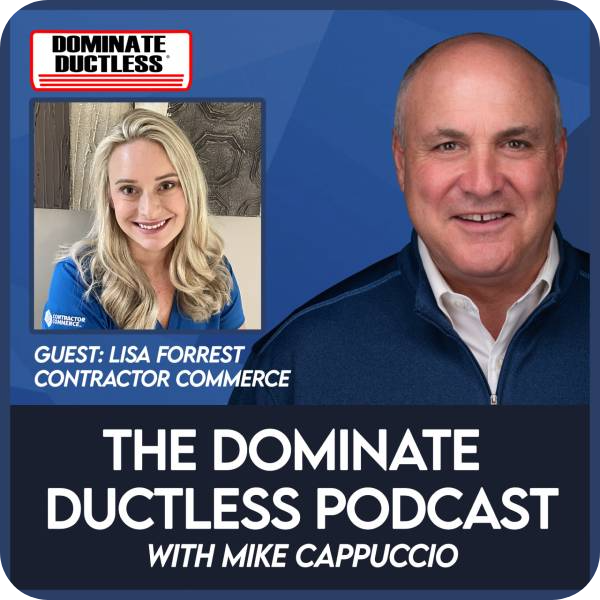
Welcome to the Dominate Ductless Podcast, where we explore the business side of heat pump installation and HVAC contracting. In this episode, I am joined by Lisa Forrest, Partnership Manager at Contractor Commerce, to discuss a game-changing shift in the HVAC industry: e-commerce platforms designed specifically for contractors. Lisa reveals how Google’s recent “online estimate” filter is revolutionizing how homeowners find contractors, why price transparency attracts serious buyers instead of scaring them away, and how contractors can finally compete with the non-contractor e-commerce companies invading their markets. If you’re ready to modernize your business, this conversation is essential listening.

You could say this episode is a wake-up call for HVAC contractors, in general.
Lisa’s explanation of Google search revelation alone is worth the listen.
The fact that Google is now actively filtering for websites that offer “online estimates” means contractors without pricing transparency are essentially invisible to a massive segment of ready-to-buy customers.
What really resonates is Lisa’s point about non-contractor e-commerce companies invading the HVAC space while traditional contractors remain stuck in an outdated “fill out a form and wait for a call back” mentality.
The real-world numbers (70% close rates!) prove that price transparency doesn’t scare customers away—it attracts serious buyers who are ready to move forward.
This isn’t about being the cheapest; it’s about meeting modern consumers where they are: online, right now, at midnight when they’re thinking about their HVAC needs.
If you’re not offering online estimates, you’re leaving money on the table and losing ground to competitors who are meeting customers where they actually are: online, right now, looking for answers. The question isn’t whether to adopt e-commerce—it’s whether you’ll do it before your market share disappears.
Listen & Subscribe:
Listen to the full episode in the player above, or listen on your preferred podcast app.




Mike: Good morning and welcome to the Dominate Ductless podcast where this morning we’re going to tell a little bit of a different story today. Um, I have a partner that Dominate Ductless has partnered with in training, and it’s my pleasure to introduce Lisa Forrest from Contractor Commerce to the podcast this morning. Good morning Lisa.
Lisa: Good morning Mike. Thanks for having me. Happy to be here.
Mike: Happy to be here too. Well, um, hey, Lisa, let’s get right into it. Um, for contractors who have never heard about Contractor Commerce, you know, give us a 60-second elevator pitch. You know what? What is it? And you know, what problems does it solve for contractors? Just give us the elevator pitch on it.
Lisa: Yeah. So simply put, it is an e-commerce platform for the trades. So we plug into the contractor’s website giving them the capability to sell their products, services and even do online estimates for homeowners. The problem it solves is homeowners are online shoppers. We can get prices on pretty much anything. Today everything’s so digital-focused. We’ve got, you know, our cell phones at our fingertips. How are you meeting that customer where they’re at? And something like a store on your website works 24/7. So meet that customer where they’re at. Open the conversation about your products and services and what you do, and allow your website to guide them through that experience through your brand.
Mike: Excellent. So as we all know, right, the HVAC industry has been very slow to adapt digitally compared to other trades. You know, why do you think that is?
Lisa: Well, I always compare it to the automotive industry. We are definitely behind the automotive industry by at least ten years, maybe even a little bit more. But I think that we have a lot of businesses where these contractors are family owned businesses or their friends or partners. And they’ve done such a good job in their community that naturally, word of mouth has brought them business. But our world has changed. Like I mentioned earlier, consumers shop online. You can get information in a matter of moments, like if I snap my fingers, I could get an answer on something. So I think there’s just that disconnect. But it is rapidly changing. So it’s definitely something that, you know, we’re passionate about educating contractors like, hey, you better do something and be a part of the conversation or you’re going to be left behind.
Mike: I keep saying that in my training because I see more e-commerce companies, I’m going to call them, that are not contractors.
Lisa: Mm. Yeah.
Mike: They’re dominating our market in a lot of areas. And I keep telling contractors you need to—I said the only way you’re going to beat these companies is by having Contractor Commerce because you just—you have to get on board, you know. And why is now the time for contractors to get on board?
Lisa: Well, I don’t know if you know this, but about six weeks ago, Google added a filter in the top near the top search bar that says “online estimate.” So if I go type something in that I’m looking for, online estimates is now a filter that you can filter down to anybody that’s talking about pricing. And I actually did a test here in my market. I live in Charlotte, North Carolina. I typed in, hey, I’m looking for an HVAC quote in Charlotte, help me or whatever verbiage I put in there. But what was really cool is when I filtered down to that online estimates, four of our customers showed up and led them right to that experience for that homeowner to begin. So when homeowners are looking for something, Google is going to act. They don’t just throw something on their website to throw it on. They’re following consumer behavior.
Mike: That’s amazing because and I think just from hearing that, I mean, if these contractors don’t get on board with online estimates, I mean, I feel like they’re all so afraid of it. I don’t know why. And I said that—I was teaching a class this week up in New Jersey, and I rolled the clock back 15 years ago. And I said, you guys all bitched and complained about when, you know, manufacturers sold products online and they showed the price of the condenser and the evaporator and everything else. And it’s like, you got to stop worrying about that because these companies now—I’m seeing, you know, like you’re saying everybody’s on board, you know. Why is everyone so afraid of showing a price to a consumer when they’re going to show it to them in their home?
Lisa: Exactly. I mean, I think before, you know, consumers were looking at pricing as a comparison, right? Because that’s all they knew. But now we’re more educated. We can get information so quickly that now it’s more about just clarity and what to expect. I want to avoid surprises. I mean, I’m a millennial, I have some traditional tendencies, but I’m a busy lady. I travel for this job. Time is of the essence. When I am looking for something, I want to get it done. I am not shopping on price like—I want to—if a company is going to reach out to me and give me the information and say, all right, we’ll come, you know, we’ll come out to verify some things. Boom. That’s somebody that I want to do business with.
Mike: Yeah. I mean, I just—I can’t understand why. You know, think about this. I mean, there’s a statistic of people over 65, 60% of them today are booking restaurants online. Yeah, 70% of those people are buying things on Amazon. I mean, and yet we’re still the antiquated—I look at so many guys who are still antiquated in this contracting world. That makes zero sense to me. So, you know, how does it work? You know, walk us through what a contractor’s website looks like once Contractor Commerce is plugged in. You know, what can a homeowner actually do there? You know, how does it all happen?
Lisa: What’s great is we plug onto their existing website. So whomever manages their website, we give them a little snippet of code that they plug on there. And then we work with the contractor to set up, you know, what parts of the service they want. Um, the cool thing is we stay on the website. We want that homeowner spending time on that contractor’s website. They’re not going to a third party page. And then really what they get to choose is, hey, do I want to sell any filters or custom products? Hey, memberships—those are your customers that are your, you know, essentially your loyalty that you see at least twice a year. Well, give them the opportunity to buy that service or renew that membership on the website because again, your website works 24/7. You probably don’t want to take a phone call at 12:00 at night when some people are night owls and they’re like, oh, I got to renew my membership.
Mike: I mean, think about that. You can sell your memberships online, you can sell your products online. And I mean, you can sell so many things. You can sell filters online. Can you talk a little bit about the filter side of it?
Lisa: Yeah. So Contractor Commerce has relationships direct with manufacturers and distributors. We stock in inventory filters at five locations all throughout the United States. And we pass the costs that we receive from that manufacturer distributor to our customer. We buy very, very, very, very many filters, lots and lots of filters. So customers see savings in that realm. They get to choose what they’re going to charge the customer, so they mark them up as high or as competitive as they want. And customers can come on, buy the filter. They can even sign up for a subscription, which I say is a no brainer. That’s another touchpoint with your customer. That’s an opportunity to put Mr. HVAC company in front of that customer throughout the year, beside a maintenance visit or, you know, whatever marketing you do currently.
Mike: I was actually just talking to a contractor the other day that I coach, and he uses your system. And he said to me, he said the biggest revenue stream that I get out of it, where people actually put their credit cards in is on my service agreements. He said people go to get the quote for the system, and then they tend to pick up the phone and they call us and stuff. He said, but he said, my revenue stream is credit card swipes, credit card swipes on my, you know, my clients. So, I mean, uh, which ones do you see? You know, contractors benefiting from the most right away when they first do it. Is there a section on the revenue stream that you see contractors benefit the most from?
Lisa: So I would say it’s the estimates part, you know. The homeowners walking through and getting that quote. That contractor’s still going out to the home to verify some things like is it really in their basement? Do they really have, um, you know, is it a single zone or is it a multi zone? They’re just verifying what the customer is entering and then they start selling the value of their company. So I’ve seen customers onboard in less than a week and already have a lead and sell a job. In fact our president just shared a note from a customer that said, hey, we got a quote last night, sold a $30,000 job in less than 24 hours.
Mike: So how long does it take to get set up, time frame?
Lisa: So we move at the speed of the contractor. It is—
Mike: Really? Well, you’re really being nice.
Lisa: I—yeah. Some are faster than others. But I’m trying to set up some pricing price books with some contractors I coach. And you know, I send them to another partner to do their coding tools for inside homes. And, you know, my partner’s telling me it should take 4 to 6 weeks max to set up an entire price book for unitary ductless everything. And here we are four and six months later. So it’s—
Mike: Tell me a little bit about this one, because this is where you—I got to have you emphasize on this to, you know, because you can’t put it all on Contractor Commerce.
Lisa: No. And that’s not the intent. This isn’t their entire price book. It’s going to be their top 40-50 matchups. That is going to answer the general questions that the homeowner is seeking. Right. And typically what I see is one, they’re either downloading their price book, they’re sending it to us. They set up a 30 to 45 minute call with our team. They have their price book pulled up, and we’re like, okay, what’s your price on a single zone in this location? Boom. We’re filling it out for them and the filters are already in the system. They’re just setting the markup. And then we build their maintenance plan. If they work with a platform like Service Titan, which we have a direct integration with, we can pull over the service membership that they have built in Service Titan over into Contractor Commerce, so that it’s a communicative integration per se. But again, like I’ve seen the whole product launched in a week. On average it’s 2 to 3 weeks for most contractors.
Mike: What softwares can you integrate with or just Service Titan—the only one or can you integrate with all through Zapier connections?
Lisa: Yes. Yep. So we do have a Zapier connection. We’ve got webhooks API. We integrate with tools like Smart AC, um, Chirp and Hatch, which are text automated follow up, uh, because some salespeople don’t typically follow up routinely.
Mike: And so there’s Hatch and Chirp. That’s interesting. Yeah. Because I was talking to a contractor again, I was doing training this week and he—and I’m not here to, you know, talk negative about anybody’s. But he had said he had left Chirp, he went to Hatch. Hatch was doing a few more things that Chirp wouldn’t do. And I guess it might be based on what they are. But I mean, those are automated softwares that are getting to the homeowners.
Lisa: Yeah, like text messaging. You know, texting has a better response rate, right? Like phone calls—people are busy. They forget someone called. But having campaigns already pre-built out for whatever facet that lead comes through, it’s a no brainer to me.
Mike: Yeah. I mean, you know, these guys, I always try to tell them, you know, you’ve got to get this stuff onto your website. So let me ask you this question. Let’s go into like a, you know, a heat pump specific angle here. And you know, we see most contractors, we have a few that are just heat pump related. And I’m seeing more going that way. But we also, you know, we have the unitary guys and we have the ductless guys that do a little bit of both, you know, for contractors who specialize in certain things. You know, how does this all work? Maybe they’re doing, you know, Mitsubishi. They might be doing another brand. You know, how does this online store give them an edge, you know, over the generalist HVAC company down the street? How is this all going to come together?
Lisa: One thing I say is it gives you the competitive edge, right? You’re the one answering what homeowners are seeking. You know, you mentioned something about, hey, homeowners are asking for online pricing—70% or more want to see a price before they work with a contractor. Um, there’s other statistics and things that are related to that, but I think it gives them the cutting edge, right? They’re able to share their service and why they’re a specialty and begin that conversation even before that homeowner picks up the phone. So that homeowner is already a little bit educated. Why? Let’s just say Dominate Ductless HVAC is the superior installer in XYZ market, and now it’s really just going in and solidifying the things and answering questions that homeowners may have because they’ve already started their research before they’ve made that decision.
Mike: I don’t know why so many guys are so afraid of it.
Lisa: I think they think that the homeowner is going to hang on to that price. Huh? They’re going to—I said, I think that they think that that homeowner is going to see that price and be like, oh, well, your website told me $12,000. Why is it now $13,500 or whatever the difference is, right? There’s ways that they can answer that question of different pricing. Um, additionally, right, like, hey, this doesn’t include, you know, us replacing, you know, lines and things like that, but they can build that value within different resources that we send to that homeowner.
Mike: Yeah. I mean, I just—I’m still—so maybe it’s just different parts of the country, I don’t know. Do you see any, you know, different variants? I mean, you do a lot of traveling. I mean, I follow you on LinkedIn, I follow you on Facebook. And I see, like, you are everywhere.
Lisa: Yeah. Well, you—I—you must have more Marriott and Delta points on whatever airline you fly.
Mike: You know, and I mean but do you see different parts of the country? You go to different events, you see different things. What do you see? What do you do? Do you feel that or is that just me?
Lisa: No, I do think that there is some truth to that. But what’s really cool is I grew up in Iowa, so anytime I see anybody from Iowa, I get really excited and I give a shout out, you know? But, you know, typically Midwestern people are a little bit more, um, guarded in that sense and want to see it doing well in other areas. But I actually talked to one of my customers in Iowa, uh, a couple of weeks ago, and they did a mailer with a QR code that had some language that said, hey, you know, interested in replacing your system or need a second opinion? Give us a call. So they did a test—within a few days, they had 20-something people walk through and get a quote. And he said, if we get that appointment booked, we’re closing them at 70% or higher.
Mike: I was like, wait, can you repeat that?
Lisa: He’s like, yeah, our close rate is 70% or higher when we get in front of that homeowner. And then the other cool part he told me was, we’re getting ready to mail out 30,000 of these. And I’m like, well, let’s have a conversation in a month because I want to see what numbers you’re doing at that point. And that’s in Iowa. In Iowa.
Mike: I—when I was in business and, you know, my marketing company helped me with this—and this is—I’m going to roll the clock back 15 years, probably. And this was about cost and it was about price. And I created or we created as a group a “Cost of Ductless” page. And when you looked at my rankings and how things, you know, were done with Google 15 years ago, ten, 15 years ago, it was the highest ranking page on my website. So that tells me people want to know four things before they go buy something. And I think you’ll vouch with me: What does it cost?
Lisa: Mhm.
Mike: How does it work? How is it going to solve my problem and how long is it going to take to get done? Yep. You know and the cost was the biggest thing. And I ask that to guys in training all the time—I’m like what is the first thing someone wants to know about what you do? And if you were thinking about buying a heat pump today, what do you want to know? They all go “cost.” Okay, but let’s not put a cost system on our website. I mean, I don’t know, you tell me, but that doesn’t sound right.
Lisa: You know, so, you know, it just doesn’t make a lot of sense. But, you know, can a contractor set up, you know, their store with features, you know, specified ductless packages like single zones, wall mounts, dual zone systems. And you know so the customer can actually get a, you know, a real quote and not just a, you know, a pricing page?
Mike: Yeah. So what we call it is a buying journey. Right. This homeowner is beginning the—yeah. This homeowner’s beginning the journey of what this service is going to cost them. Right. So they’re entering a little bit of information about themselves—name, phone number, where they live. Because we want to make sure these are opportunities within that contractor’s service area. So someone like me—I’m not getting a quote in Boston, Massachusetts, I’m nowhere near any contractor in that way. So it’s going to stop me there. Then it starts asking qualifying questions and what that homeowner is looking for, like you mentioned, you know, single zone or multi zone or, you know, location and those types of—yeah those types of situations affect the price.
Lisa: And then what comes out at the end is a good, better, best or however they label their packages and they get to curate that experience. Whether, hey, I just want to show a monthly price because a lot of homeowners are financing, so I want to give them that monthly investment. They can show both. They can say, hey, this is a fully installed price. Some contractors use that language because they want to price condition the homeowner and weed out the tire kickers. Some will say things like this is an estimated install price or “starting at” because it doesn’t include things like additional line sets and maybe the membership that you’re going to include. So again, it’s curated to what they want that experience to be for the homeowner.
Mike: Yeah, I keep saying to guys, you know, I even—I was thinking about this the other day is, you know, I see a lot—I’m really promoting in this first module. My training is really very high on the power of video, the power of video, the power of video and everyone, you know TikTok, social media, Instagram, Facebook, LinkedIn, all these social platforms. And I see a lot of them that don’t have—they do video and they have no strategy with it. And the strategy part of it, I think would run so great with this tool because I’m looking at, you know, “Learn More.” I can hit a Learn More button on a social site and then go somewhere and go do something. And to me that could be the buyer’s journey.
Lisa: Yeah.
Mike: Or you know, when people say, you know, they hit the, you know, “Get an Estimate” or, you know, “Request an Estimate.” Okay, I’m thinking I’m going to press that and I’m going to have to fill all this stuff out. And then someone’s going to call me and blah blah, blah, blah blah where I would say, “Request an Estimate.” Boom, go right here. Here’s your estimate.
Lisa: Yeah.
Mike: Why do I even need to—I’m just—I’m looking at that speed to lead section. And so people filling out forms and contractors calling back. That is such an antiquated system in today’s marketplace. But you can’t believe how many of them are still doing that in today’s world.
Lisa: Yeah, they just don’t know. Right. Or there’s—like you said, they’re scared to do it. But I mean, we’re working with well over a thousand contractors and growing each and every day that, you know, and I think my favorite part of it is the ones that say, oh, I’m never going to do this. Or I looked at you guys a couple years ago, but it’s time because, you know, whether it’s the Google filter or customers calling in, hey, I need a ballpark quote. I need a ballpark quote. They’re like, we got to get ahead of this.
Mike: I gotcha. So I mean, now they’re not just going to a “Call Us” and a pricing page. You know, they’re going to real life things, you know. So I mean, give us a real world example of, you know, what kind of results Contractor Commerce is seeing in terms of leads, you know, maybe revenue or time saved. Is there any real world examples you can give us on something like that?
Lisa: Man, I have many. And that’s one thing. Like when we meet with contractors, we share some stories or we’ll pull up a contractor within their region that they may know, like, hey, this is what so-and-so is doing. Um, but what I’ll tell you as a general roll up is of the customers that go through and get an estimate, about 45% are booking into an in-home visit. Once that happens, the close rate is 70% or higher.
Mike: Wow. Yeah. That’s—you know what? If someone knows what something costs and they have you to their house—
Lisa: It’s sold.
Mike: Right.
Lisa: I agree with you 100%. Think about this. If you went online, you got a quote, you got an estimate and you went to someone and now they’re inviting you to their home to pretty much sign up. I mean, I think you could even—I mean, I’m seeing honestly, on e-commerce, the guys that aren’t contractors have even gotten a step more advanced.
Mike: Yeah.
Lisa: Yeah, well, they’re swiping the card, and they haven’t even done a job yet.
Mike: They’ve got nothing. Oh my God. And I keep telling guys they’re invading your marketplace guys. So if you want to, you know, if the internet screen is stealing your business, you better get on board.
Lisa: Oh for sure. Because I think—
Mike: In your business.
Lisa: Yeah, I encourage contractors that are listening to this—like go type in, hey, I’m looking for an HVAC quote in your city and see what pops up. You’re going to see there’s very few contractors that are answering that question. It’s your tech companies and your lead funnels, which those are great tools. But again, they’re not the trusted contractor that’s in the home meeting with that customer. Or it’s a retailer, you know, like a big box store, which again, contractors that are listening to this and that we work with Mike, aren’t going to a home and installing a dropship unit from a retailer. So again—
Mike: They’ve introduced—I think that’s one advantage we do have over the big box retailers. You know, I mean, I don’t know, I mean, we live in a very fast world where a lot of e-commerce is going on. I’m not going to—I’m not going to even say what I’m thinking right now, but everyone probably knows what I’m thinking. And, you know, there’s a few big e-commerce contractors out there. I mean, and I’m going to tell you, I had a conversation with a contractor the other day in California who was thinking about creating a nationwide company that doesn’t do work. And I keep saying this to guys. There’s a ton of low barrier to entry contractors in the United States right now. And I don’t know if this is something that has to do with consolidation. But over probably the last 20 classes that I’ve taught—and I might have 20 to 30 contractors in them—30 to 40% of guys are 1 to 3 man shops who have been in business less than two, three years. That’s kind of telling me something.
Lisa: Yeah, we’ve got this whole group of new people that are coming in and they’re hungry for work, and a lot of them are being fed by these e-commerce companies. So just a warning, guys, for anyone that’s listening. Okay. This market’s changing. This business is changing. Everything’s changing. So you know what does the investment look like? You know because every contractor that’s listening to this is always going to go like well, what does it cost? You know, I mean, is it a crazy figure? And look, we’re talking about price.
Mike: So let’s get to the nitty gritty here.
Lisa: Exactly. And you can visit ContractorCommerce.com. And we’ve got our pricing live because man that’d be one thing if we’re preaching price.
Mike: And then they’ll show you a price.
Lisa: That’s not going to be good. That’d be like—totally miss the point. But um, investment starts at $500 a month, which can fit, you know, a lot of contractors’ needs. We do have some higher plans, but that gets access to the entire platform. So $6,000 for the year. I mean, you could sell three systems and cover your costs, and that happens within a month.
Mike: Three systems off of this software, you would have a big problem.
Lisa: Especially with how Google is ranking things today of what you’ve just told us, because that’s a huge secret that I don’t think many contractors actually know.
Mike: Yeah, I have to actually go on and research that myself and go look at that, you know, to see how that’s all going to play out, you know? So, um, I mean, if a contractor leaves my training, you know, today and wants to get started, what’s the first step? You know, what do I tell them? What can they expect in the first 30 to 60 days?
Lisa: Yeah. So we make the process simple. They’re just signing up for the plan of their choice, and then we start onboarding with them. So getting their company profile, getting plugged onto the website, getting the pricing. So what element of the software are you really wanting to hone in and launch first? Typically that’s the pricing because that’s where the ROI is at. And like I mentioned earlier, anywhere from 2 to 3 weeks onboarding. Um, we are giving them the first month essentially off so they don’t pay for the service until after 30 days, because we want to get them onboarded and live with some strategies like marketing. And we can get into that, you know, when we meet with your customers if they’re interested. But yeah, we make it simple.
Mike: Simple is easy. That’s what I say. Don’t make it harder than it is. Well, Lisa, I want to thank you today for coming on. I think this is fantastic information. I can’t wait to get the podcast. I’ll edit it and kind of get it put together. We’ll get the ums and ahs out of it. And, you know, I really will clean this up and get this to the contractors. And we’re going to promote this and really move on with this. But again, thank you so much for coming on and joining us. I know we’ve been trying to get this done for the past 2 or 3 months. And you’re just a busy girl. So go out there and continue knocking them dead. And you know, congratulations on your improvements and, you know, climbing up that corporate ladder and just keep doing what you’re doing. So all right.
Lisa: I appreciate it, Mike. And it’s good to partner with you. And thanks for believing in what we do.
Mike: Thank you so much. Have a great day.
Lisa: You too. Bye.
Mike: See you. Bye bye.
End of Transcript
For more information about Contractor Commerce, visit: www.contractorcommerce.com
Contractor Commerce Website: https://www.contractorcommerce.com
Pricing: Starting at $500/month ($6,000/year)
Key Integrations:
Platform Features:
Setup Timeline: 2-3 weeks average (as fast as 1 week)
Support: 30-45 minute onboarding call with team to set up pricing
For more information about Contractor Commerce, visit: www.contractorcommerce.com
